Is there wealth tax in Switzerland? Yes. Switzerland is one of only four OECD countries that levies a comprehensive annual wealth tax on net assets. However, there is no federal wealth tax. It is purely cantonal and municipal, with effective rates ranging from just 0.13% in Nidwalden to around 0.76% in Geneva. A married couple with CHF 1 million in net wealth pays approximately CHF 1,250 per year in Nidwalden versus CHF 5,100 in Geneva. Where you live matters enormously.
When I first reviewed my Swiss tax assessment after moving here, I was struck by an item I had never encountered in my years at JPMorgan: Vermögenssteuer, the wealth tax. Coming from jurisdictions that tax capital gains heavily but ignore accumulated wealth, the Swiss approach felt backwards at first. Tax what you own rather than what you earn from selling it?
After a decade of investing and building a seven-figure portfolio in Switzerland, I now see the wealth tax as one of the best deals in global taxation. Yes, you pay a small annual fee on your net worth. But in exchange, you keep 100% of your capital gains tax-free. For long-term investors focused on wealth accumulation, this trade-off is extraordinarily favorable.
In this guide, I will walk you through exactly how Swiss wealth tax works, show you the real numbers across every major canton, and share the legal strategies I use to minimize the bill while staying fully compliant.
How Swiss Wealth Tax Works
Unlike most countries that have abandoned wealth taxes (the US, UK, and Germany never had one; France abolished its comprehensive version in 2018), Switzerland maintains a wealth tax at the cantonal and municipal level. There is no federal wealth tax. The legal basis is the Federal Tax Harmonisation Act (StHG), which sets the framework but lets each of the 26 cantons and roughly 2,000 municipalities determine their own rates, exemptions, and multipliers.
This decentralized system creates the largest internal tax variation of any Swiss tax. Two people with identical net worth can pay wildly different amounts depending solely on their address.
The December 31 Snapshot
Swiss wealth tax is assessed on your worldwide net assets as of December 31 each year. Only this single date matters. If your portfolio crashes in January, that has no effect on your prior year’s bill. If it surges in December, you pay on the higher value.
Net wealth equals total gross assets minus deductible debts. Mortgages, personal loans, credit card balances, and outstanding tax liabilities are all fully deductible with no cap.
Who Pays
Anyone who is a Swiss tax resident pays wealth tax on worldwide assets, regardless of nationality or permit type. Residency is triggered by domicile, or by staying 30 or more days while working, or 90 or more days without gainful activity. If you arrive or leave Switzerland mid-year, the tax is pro-rated based on your days of residency.
Married couples have their assets combined and taxed jointly, which affects both the applicable rate (usually more favorable) and the tax-free allowance.
What Gets Taxed (And What Does Not)
The wealth tax base is broad. Almost everything you own counts. But there are important exemptions that smart investors leverage.
Taxable Assets
| Asset Type | Valuation Method |
|---|---|
| Bank accounts (Swiss and foreign) | December 31 balance |
| Securities (stocks, ETFs, bonds, funds) | Year-end market value per ESTV Kursliste |
| Real estate | Cantonal Steuerwert (typically 60-80% of market value) |
| Vehicles, boats, aircraft | Market value (Eurotax for cars) |
| Cryptocurrency and digital assets | December 31 price per ESTV Kursliste |
| Life insurance (cash-surrender value) | Surrender value at year-end |
| Art, jewelry, collectibles | Market value if significant |
| Private company shares | Praktikermethode: (2 × earnings + 1 × book value) / 3 |
Exempt Assets
These assets are NOT subject to wealth tax:
- Pillar 2 (BVG) occupational pension assets, fully exempt until payout
- Pillar 3a tied private pension assets, fully exempt until withdrawal
- Household goods and personal effects (furniture, clothing, everyday items)
- Non-surrenderable life insurance
- Foreign real estate (exempt from Swiss tax but “rate-determining,” meaning it raises your applicable rate)
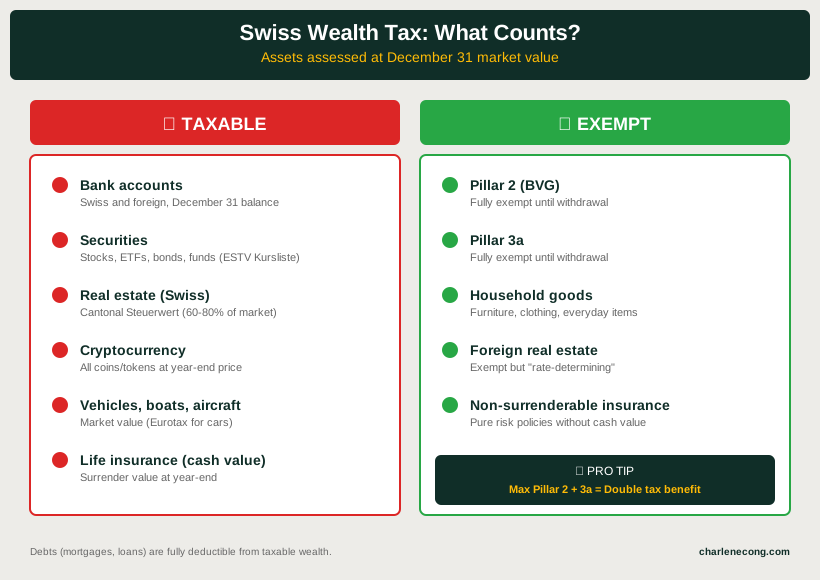
The pension exemption is crucial. Every franc you contribute to Pillar 2 or Pillar 3a leaves your taxable wealth base immediately. This double benefit (income tax deduction plus wealth tax exemption) makes pension contributions one of the most powerful optimization tools available.
The Numbers: Cantonal Wealth Tax Rates for 2026
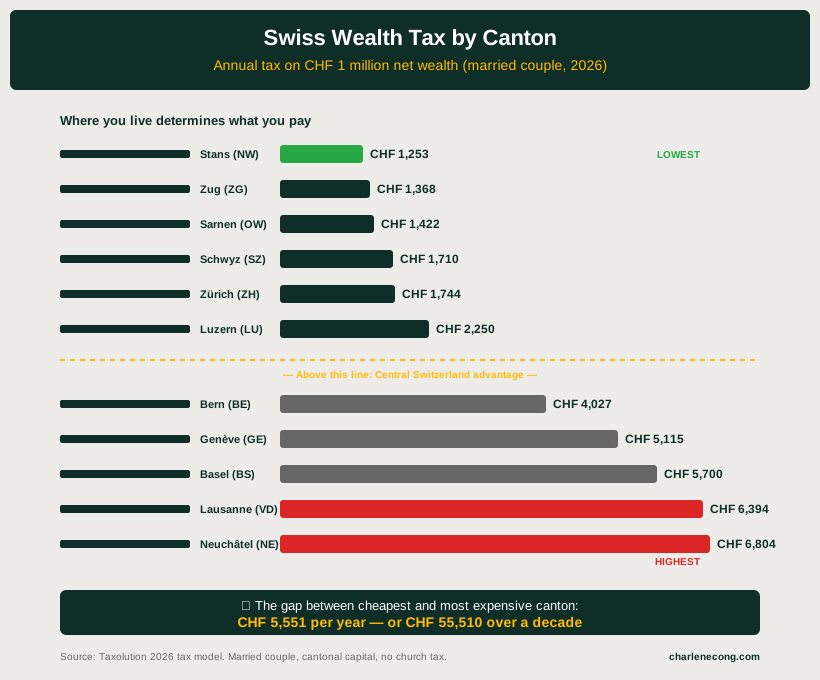
Here is where it gets interesting. The same CHF 1 million in net wealth can cost you anywhere from CHF 1,253 to CHF 6,804 per year depending on your canton. At CHF 5 million, the gap exceeds CHF 31,000 annually.
The following table shows the annual wealth tax bill for a married couple in each cantonal capital, excluding church tax, for tax year 2026:
| Canton (City) | CHF 500k | CHF 1m | CHF 2m | CHF 5m |
|---|---|---|---|---|
| Zug (ZG) | 412 | 1,368 | 3,578 | 10,208 |
| Stans (NW) | 626 | 1,253 | 2,505 | 6,263 |
| Sarnen (OW) | 711 | 1,422 | 2,844 | 7,110 |
| Schwyz (SZ) | 855 | 1,710 | 3,420 | 8,550 |
| Luzern (LU) | 1,125 | 2,250 | 4,500 | 11,250 |
| Zürich (ZH) | 467 | 1,744 | 5,543 | 22,866 |
| Bern (BE) | 1,596 | 4,027 | 9,734 | 27,630 |
| Basel (BS) | 2,450 | 5,700 | 13,320 | 37,020 |
| Genève (GE) | 2,106 | 5,115 | 12,680 | 38,114 |
| Lausanne (VD) | 2,553 | 6,394 | 14,310 | 38,057 |
| Neuchâtel (NE) | 2,508 | 6,804 | 13,608 | 34,020 |
Source: Taxolution 2026 tax model. Married couple, cantonal capital, no church tax. Green = lowest rates, red = highest rates.
Key Patterns to Notice
Zurich is deceptively cheap at lower wealth levels. The high tax-free allowance (CHF 159,000 for married couples) means you pay just CHF 467 on CHF 500,000. But the steep progression kicks in hard: at CHF 5 million, Zurich charges CHF 22,866, nearly four times more than flat-rate Nidwalden.
Flat-rate cantons scale linearly. Nidwalden, Schwyz, Obwalden, and a few others use flat rates rather than progressive brackets. Their advantage compounds with wealth. At CHF 5 million, Stans (CHF 6,263) is the cheapest in Switzerland.
French-speaking cantons are consistently expensive. Geneva, Vaud, and Neuchâtel cluster at the top of the table at every wealth level. If you live in Romandie, the bouclier fiscal (tax shield) becomes important.
Even within cantons, municipality matters. In Zurich, the tax multiplier ranges from 71% in Zumikon to 119% in the city. Choosing the right municipality can cut your bill by 30% or more.
Tax-Free Allowances by Canton
Most cantons exempt a portion of wealth from taxation. These allowances vary significantly:
| Canton | Single | Married |
|---|---|---|
| Zurich | CHF 80,000 | CHF 159,000 |
| Geneva | ~CHF 82,000 | ~CHF 164,000 |
| Bern | CHF 100,000 threshold | |
| Schwyz | CHF 125,000 | CHF 250,000 |
| Basel-Stadt | CHF 75,000 | CHF 150,000 |
| Nidwalden | Minimal (flat rate applies) | |
Cryptocurrency and Digital Assets
Switzerland’s treatment of cryptocurrency is remarkably clear compared to most jurisdictions, and it is one of the reasons Zug earned its “Crypto Valley” reputation.
For wealth tax purposes, crypto is classified as movable intangible property, similar to foreign currency or securities. All holdings must be declared at their December 31 market value using the official ESTV Kursliste, which publishes year-end prices for major coins including Bitcoin, Ethereum, Litecoin, and Ripple. For tokens not on the list, use the price from your primary exchange or CoinMarketCap.
The crypto advantage: While your holdings are subject to wealth tax, capital gains from selling crypto remain tax-free for private investors who meet the same five safe-harbor criteria as securities. Buy Bitcoin at CHF 10,000, sell at CHF 100,000, and you owe zero capital gains tax. You only pay the modest annual wealth tax on your holdings.
What Is Taxable as Income
Not all crypto activity is tax-free. The following generate taxable income at your marginal rate:
- Mining rewards at the value when received
- Staking rewards at the value when received
- Lending interest (e.g., from DeFi protocols)
- Yield farming and liquidity mining rewards
- Airdrops if received in exchange for some action
Crypto-to-crypto swaps (like exchanging Bitcoin for Ethereum) are tax-neutral for private investors. You do not trigger a taxable event until you convert to fiat currency, and even then, only if you are classified as a professional trader.
CARF Coming in 2026
New reporting requirement: From January 1, 2026, Switzerland implements the OECD Crypto-Asset Reporting Framework (CARF). Crypto exchanges and service providers will be required to report your holdings to tax authorities, with the first international data exchange expected in 2027-2028. If you have undeclared crypto, now is the time to correct your filings.
How Switzerland Compares Globally
Switzerland is one of only four OECD countries that still levy a comprehensive net wealth tax, alongside Norway, Spain, and Colombia. Most developed nations have abandoned wealth taxes entirely. The United States, United Kingdom, Germany, and the majority of the EU have none.
But here is the key insight: even among countries with wealth taxes, Switzerland’s rates are exceptionally low.
| Country | Top Rate | Annual Tax on CHF 5m |
|---|---|---|
| Norway | 1.1% above NOK 20.7m | ~CHF 52,000 |
| Spain (Catalonia) | Up to 2.75-3.5% | ~CHF 45,000 |
| Switzerland (Geneva) | ~0.76% effective | CHF 38,114 |
| Switzerland (Nidwalden) | ~0.13% flat | CHF 6,263 |
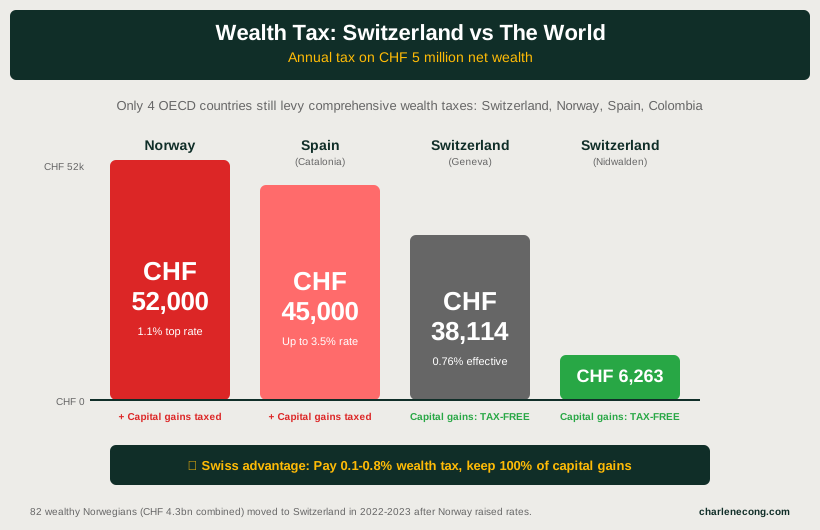
Norway’s wealth tax has become notorious for driving wealthy residents abroad. According to Norway’s Finance Ministry, 82 wealthy Norwegians with a combined net worth of about NOK 46 billion (CHF 4.3 billion) left the country in 2022-2023 after the top rate increased to 1.1%. More than 70 of them moved to Switzerland.
“The wealth tax is the price of admission to one of the world’s best tax environments. A few thousand francs a year to keep 100% of your capital gains? That is a trade I will take every time.”
Five Legal Strategies to Reduce Your Wealth Tax
The Swiss system offers several legitimate ways to minimize your wealth tax bill. Here are the most effective strategies I have seen work.
1. Choose Your Canton and Municipality Wisely
This is by far the biggest lever. If you have flexibility in where you live, the difference between Geneva and Zug at CHF 5 million is CHF 27,906 per year. Over a decade, that is nearly CHF 280,000.
The lowest-tax cantons for wealth are Nidwalden, Obwalden, Schwyz, and Zug. Within each canton, specific municipalities can cut another 20-30% off the bill. In Zurich, Zumikon (71% multiplier) charges roughly 40% less than the city of Zurich (119% multiplier).
Below CHF 1-2 million in net wealth, the savings may not justify relocating. Above that threshold, it becomes material.
2. Maximize Pillar 2 and Pillar 3a Contributions
Every franc inside your pension accounts is exempt from wealth tax. This makes pension contributions doubly powerful: you get an income tax deduction when you contribute, and you remove the assets from your wealth tax base.
For 2026, the Pillar 3a maximum is CHF 7,258 for employees with a pension fund. Pillar 2 voluntary buy-ins have no fixed cap and can be spread over multiple years to maximize the income tax benefit. Note the three-year blocking period before you can take a lump-sum withdrawal after a buy-in.
From 2026, retroactive Pillar 3a contributions are also permitted to fill gaps from prior years, creating additional opportunities.
3. Leverage Mortgage Debt Strategically
Swiss real estate is assessed at the cantonal Steuerwert, typically 60-80% of market value. But your mortgage is deductible at full face value. This structural mismatch means holding property with a mortgage reduces your taxable wealth compared to holding the equivalent equity in cash.
For more on the math of property ownership in Switzerland, see my dedicated guide.
4. Use the Tax Shield in Geneva and Vaud
If you live in Geneva or Vaud and have significant assets but limited income (common for early retirees or those living off investment returns), the bouclier fiscal caps your combined income and wealth tax at 60% of net income. There is a floor assuming at least 1% return on net wealth, but this can still provide substantial relief.
Aargau has a similar cap at 70%, and Valais and Ticino have narrower versions. If you are asset-rich and income-poor, check whether you qualify.
5. Time Major Transactions Around December 31
Since only the December 31 snapshot counts, timing matters. If you are planning a large asset purchase, completing it in early January rather than late December keeps it out of that year’s wealth base. Conversely, if you are selling assets or receiving a large bonus, December timing may be preferable depending on your overall situation.
For those leaving Switzerland, coordinating your departure date relative to the calendar year can affect your pro-rated tax bill.
Special Rules for Expats
If you are an expat on Quellensteuer (withholding tax), there are several traps to be aware of.
The Quellensteuer Asset Threshold Trap
Critical for expats: Quellensteuer covers your employment income tax only. It does NOT cover wealth tax. You can be pulled into ordinary assessment (Ordentliche Veranlagung) and required to file a full tax return by exceeding cantonal asset thresholds:
- Zurich: CHF 80,000 single / CHF 160,000 married
- Bern: CHF 150,000
- Schwyz: CHF 50,000 (the lowest in Switzerland)
Other triggers include gross income over CHF 120,000 or non-withheld income of CHF 3,000 or more.
Once you switch to ordinary assessment, the decision is irrevocable since 2021. You cannot go back to pure withholding tax status.
Worldwide Asset Declaration
All worldwide assets must be declared, including foreign bank accounts, brokerage accounts, real estate, and pensions. Switzerland has automatic exchange of information (AEOI) agreements with over 100 countries and has been sharing financial account data annually since 2018.
Between 2010 and 2020, roughly 155,658 taxpayers voluntarily disclosed CHF 66.4 billion in previously undeclared assets using the one-time penalty-free disclosure program. If you have gaps in your filings, now is the time to correct them before the authorities discover them through AEOI or the new CARF crypto reporting.
Foreign Pensions
Foreign pension assets are often excluded from taxable wealth but should still be declared. Cantonal practice varies. UK and US pensions are typically not taxed as wealth while you are accumulating, but the treatment on withdrawal differs. Get specific advice for your situation.
Recent Changes and What Is Coming
The Swiss tax landscape is evolving in investors’ favor. Here are the key recent developments:
Cantonal Rate Cuts (2025-2026)
Multiple cantons have reduced wealth tax rates:
- Zurich: Cantonal multiplier cut from 98% to 95% for 2026-2027, the biggest reduction in over 20 years. Additionally, 33 municipalities lowered their multipliers for 2026
- Geneva: The LEFI reform (January 2025) delivered a 15% across-the-board wealth tax cut
- Lucerne: Tax units reduced from 1.60 to 1.55 (2025) and further to 1.45 (2026), with 1.40 planned for 2027
- Schwyz: Multiplier trimmed from 115% to 110% for 2026
Eigenmietwert Abolition (Approved September 2025)
Swiss voters approved the abolition of Eigenmietwert (imputed rental income taxation on owner-occupied homes) with 57.7% in favor. This ends roughly 90 years of taxing a fictional rental income on your own home, but it also removes mortgage interest and maintenance deductions.
The earliest implementation is January 1, 2028. Importantly, this does not change the wealth tax treatment of property. Your home will still be assessed at the cantonal Steuerwert and included in your taxable wealth.
Federal Inheritance Tax Rejected (November 2025)
Voters decisively rejected (78.3% against) an initiative that would have imposed a 50% federal inheritance tax on estates above CHF 50 million. This confirms the stability of Switzerland’s low-tax framework and reassures wealthy residents that the system is not trending toward higher taxation.
Want to build wealth and be tax efficient in Switzerland?
Join my free 90-minute investment training where I walk through the complete framework for building wealth in Switzerland, including tax-efficient strategies for every stage of your journey.
Frequently Asked Questions
How much is wealth tax in Switzerland?
Wealth tax rates vary significantly by canton, ranging from approximately 0.13% to 0.76% of net wealth. For a married couple with CHF 1 million in net assets, the annual bill ranges from about CHF 1,250 in Nidwalden to CHF 6,800 in Neuchâtel. There is no federal wealth tax. The total amount depends on your canton, municipality, marital status, and total net worth after deducting debts.
Is cryptocurrency subject to Swiss wealth tax?
Yes. Cryptocurrency is classified as movable property and must be declared at its December 31 market value using the official ESTV Kursliste. However, capital gains from selling crypto remain tax-free for private investors who meet the safe-harbor criteria. Only the annual wealth tax applies, not capital gains tax. From 2026, crypto exchanges must report holdings under the new CARF framework.
Are pension assets taxed as wealth in Switzerland?
No. Pillar 2 (occupational pension) and Pillar 3a (tied private pension) assets are fully exempt from wealth tax while you are accumulating them. This makes pension contributions a powerful tax shelter: you get an income tax deduction when contributing and remove the assets from your wealth tax base. The exemption ends when you withdraw the funds, at which point they become taxable wealth if not spent.
Which Swiss canton has the lowest wealth tax?
Nidwalden has the lowest effective wealth tax rates in Switzerland, followed by Obwalden, Schwyz, and Zug. At CHF 5 million in net wealth, a married couple pays approximately CHF 6,263 per year in Nidwalden versus CHF 38,114 in Geneva. These central Swiss cantons use flat rates rather than progressive brackets, so their advantage increases with higher wealth levels.
Do expats on Quellensteuer pay wealth tax?
Quellensteuer (withholding tax) covers income tax only, not wealth tax. However, expats can be pulled into ordinary assessment if they exceed certain thresholds: gross income over CHF 120,000, taxable assets above cantonal limits (CHF 80,000 single in Zurich, CHF 50,000 in Schwyz), or non-withheld income of CHF 3,000 or more. Once switched to ordinary assessment, the decision is irrevocable since 2021.
How can I reduce my Swiss wealth tax legally?
The most effective legal strategies include: (1) choosing a low-tax canton and municipality if you have flexibility, (2) maximizing Pillar 2 and Pillar 3a contributions since pension assets are exempt, (3) maintaining mortgage debt on property since real estate is assessed below market value while debt is fully deductible, (4) using the bouclier fiscal tax shield in Geneva or Vaud if you are asset-rich but income-poor, and (5) timing major transactions around the December 31 valuation date.
Swiss wealth tax exists, and you will pay it on virtually everything you own. But step back and look at the complete picture: you are paying perhaps 0.1% to 0.8% of your net worth annually in exchange for zero capital gains tax, competitive income tax rates, political stability, and one of the highest qualities of life in the world.
Norway charges over 1% and still taxes capital gains. Spain can take over 2% in high-tax regions. France drove out its wealthy residents so aggressively with wealth taxes that it eventually abolished most of the system.
Switzerland has found the balance. The wealth tax generates meaningful revenue (4.3% of total tax receipts, the highest share in the OECD), but rates remain low enough that wealthy residents stay rather than flee. The trend is toward lower rates, not higher, with multiple cantons cutting taxes for 2025-2026 and voters decisively rejecting new wealth-related levies.
For investors focused on long-term wealth building, this is close to an ideal environment. You accumulate assets, pay a modest annual fee, and keep every franc of appreciation when you eventually sell. The math works decisively in your favor.
Disclaimer: This article is for educational purposes only and does not constitute financial, investment, tax, or legal advice. Tax rates and regulations change frequently. Consult a qualified Swiss tax advisor for advice specific to your situation. Figures shown are estimates based on publicly available cantonal tax models and may differ from your actual tax bill.

Charlene Cong, CFA, based in Zurich, Switzerland, is the founder of FinFit Solution and VISION Investment Academy. She is a seasoned Chartered Financial Analyst (CFA) with over a decade of experience in finance and banking across Asia and Europe.
Her career includes a notable tenure at JPMorgan and serving as an executive board member of the Swiss Capital Market Forum Association. She also has over seven years of experience as a banking journalist, where she investigated the investment strategies of high-net-worth individuals.