When I first moved to Switzerland, I stared at my pay slip completely confused. There were deductions for something called “AHV,” another chunk going to “BVG,” and I had no idea what any of it meant. Fast forward 10 years, and after working at JPMorgan and building a 7-figure portfolio, I can tell you: the Swiss pension system is actually brilliant once you understand it. And understanding it could mean the difference between retiring comfortably or scrambling to make ends meet.
How does the Swiss pension system work? Switzerland uses a 3-pillar system: Pillar 1 (AHV/AVS) is the state pension covering basic needs, funded by mandatory salary deductions of 4.35% from both you and your employer. Pillar 2 (BVG/LPP) is your employer pension maintaining your lifestyle, mandatory for salaries above CHF 22,680. Pillar 3a is your private pension with tax benefits up to CHF 7,258 annually. Together, Pillars 1 and 2 is supposed to replace about 60% of your final salary.
How Does the Swiss Pension System Work? The 3-Pillar Overview
Think of the Swiss pension system like a three-layer cake. Each layer has a specific purpose, and you need all three for the cake to be complete.
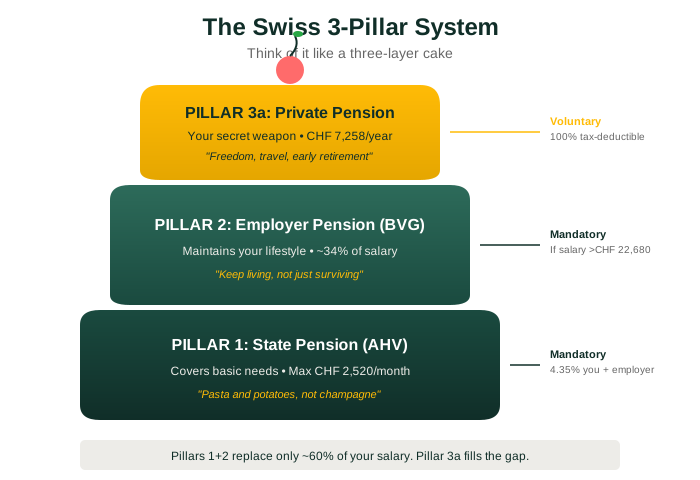
Pillar 1 is the foundation. It covers your basic survival needs. We’re talking pasta and potatoes, not champagne in St. Moritz.
Pillar 2 is the middle layer. It maintains your lifestyle so you don’t have to drastically downgrade when you stop working.
Pillar 3a is the icing. It gives you actual freedom, the ability to travel, pursue hobbies, or retire early.
Here’s the uncomfortable truth: Pillars 1 and 2 together typically replace only 60% of your final salary. I once sat down with a friend in Zurich earning CHF 150,000. She was confident her pension would cover her lifestyle. When we ran the numbers, her pension would replace only 30-40% of her current income as she is an expat and didn’t spend all the working years here.

Pillar 1: The State Pension (AHV/AVS)
Pillar 1 is mandatory for everyone who works or lives in Switzerland. It’s called AHV in German (Alters- und Hinterlassenenversicherung) or AVS in French.
How Much Do You Pay?
You pay 4.35% of your salary, and your employer matches that amount. If you earn CHF 6,000 per month, both you and your employer contribute about CHF 261 each. The good news? It’s automatically deducted from your salary, so you don’t need to worry about making payments yourself.
What Will You Get?
The maximum AHV pension in 2026 is CHF 2,520 per month for a single person. For married couples, there’s a cap at 150% of the maximum single pension (CHF 3,780). To receive the maximum, you need to have contributed for 44 years and earned an average annual income of at least CHF 88,200.
Let’s be realistic: CHF 2,520 won’t make you rich. It might cover rent (depending on where you live), groceries, and basic healthcare. But that’s about it.
| Years Worked in Switzerland | Impact on Pension |
|---|---|
| Full 44 years | Full pension (up to CHF 2,520/month) |
| Missing 1 year | Pension reduced by ~2.3% |
| Missing 10 years | Pension reduced by ~23% |
NEW: The 13th AHV Pension (December 2026)
Starting December 2026, Swiss pensioners will receive a 13th pension payment for the first time. This additional payment equals 1/12 of your total annual pension, effectively giving you an extra month’s pension at year-end. According to the Federal Social Insurance Office, this was approved by Swiss voters in March 2024 and will be paid automatically to anyone receiving an AHV pension in December.
Tip for Expats: If you’re not working for a period, you can still pay into Pillar 1 voluntarily. This is common among people on career breaks or those supporting a partner. It keeps your contribution record complete and protects your future pension.
Pillar 2: Your Employer Pension (BVG/LPP)
Pillar 2 is the occupational pension, and for many expats, this becomes the largest chunk of retirement savings. If you earn more than CHF 22,680 per year (2026 threshold), your employer is legally required to set up a Pillar 2 account for you.
How It Works
Both you and your employer contribute to this account. The money is invested and grows over time. Unlike Pillar 1 where you’re paying for current retirees, Pillar 2 is YOUR money, saved specifically for YOUR retirement.
The minimum conversion rate for mandatory BVG is 6.8%. This means if you have CHF 500,000 in your Pillar 2 at retirement, you’d receive CHF 34,000 per year (or CHF 2,833/month) as a pension. However, the average conversion rate including extra-mandatory portions has dropped to around 5.3% according to the Swisscanto Pension Fund Study.
Lump Sum or Annuity?
When you retire, you have two options for your Pillar 2:
| Option | Pros | Cons |
|---|---|---|
| Monthly Pension (Annuity) | Guaranteed income for life; protection against longevity risk | Lower flexibility; money doesn’t go to heirs after death |
| Lump Sum | Full control; can invest yourself; passes to heirs | Investment risk is yours; could run out |
| Combination | Best of both worlds | More complex to manage |
Negotiation Tip: When negotiating salary, many expats forget to ask about pension contributions. Some companies offer options like “you contribute 10%, they match 10%” versus “you contribute 15%, they contribute 20%.” The employer contribution is essentially free money for your retirement. Always ask.
Pillar 3a: Your Secret Weapon
If Pillars 1 and 2 are must-haves, Pillar 3a is the game-changer, especially for expats as we normally have so many gap years. This is where I invest 99% in global equities, and it’s the single most powerful financial tool for expats.
Why Pillar 3a Matters
With Pillars 1 and 2, you don’t control how your money is invested. The pension funds handle investments for you, usually in low-risk, low-return funds giving you maybe 0-2% per year. Your money just sits there. Boring. Tiny return.
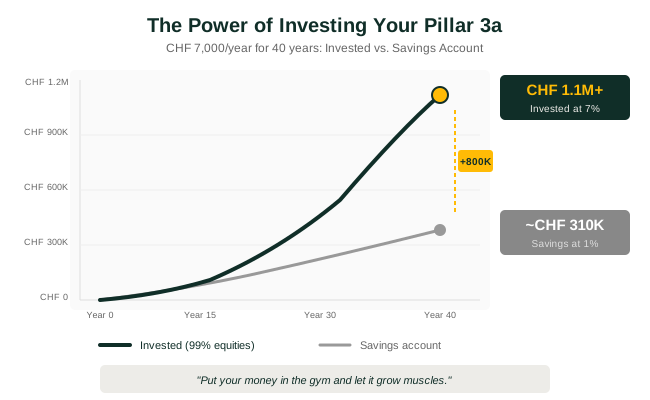
With Pillar 3a, YOU decide where to invest. I choose to invest my savings in higher-risk funds, like 99% global equities through low-cost funds. Why? Because this is money for retirement decades away. It makes sense to go for higher-growth investments. It’s like putting your money in the gym, letting it grow muscles.
The math: CHF 7,000 per year for 40 years at 7% return = over CHF 1 million. Same amount in a savings account? Maybe CHF 300,000.
2026 Contribution Limits
| Situation | Maximum Annual Contribution |
|---|---|
| Employed with Pillar 2 | CHF 7,258 |
| Self-employed without Pillar 2 | 20% of net income, max CHF 36,288 |
NEW in 2026: Retroactive Contributions
This is huge. Starting in 2026, you can make up for missed Pillar 3a contributions from 2025 onwards, for up to 10 years back. According to UBS and Swiss Life, the rules work like this:
- You must first contribute the full amount for the current year (CHF 7,258)
- Then you can make one additional payment to close a previous year’s gap
- The gap must be from 2025 or later (pre-2025 gaps cannot be filled)
- Both contributions are fully tax-deductible
Example: You moved to Switzerland in July 2025 and only contributed CHF 2,000 to your 3a that year. Your gap for 2025 is CHF 5,258. In 2026, you can pay CHF 7,258 (2026 contribution) plus CHF 5,258 (2025 gap) = CHF 12,516 total deduction. At a 30% marginal tax rate, that saves you about CHF 3,755 in taxes instead of the usual CHF 2,177.
Tax Savings Calculator
| Taxable Income | Canton | Approx. Tax Saved on CHF 7,258 |
|---|---|---|
| CHF 80,000 | Zurich | ~CHF 1,800 |
| CHF 120,000 | Zurich | ~CHF 2,200 |
| CHF 150,000 | Geneva | ~CHF 2,500 |
| CHF 80,000 | Zug | ~CHF 1,200 |
Source: Federal Tax Administration tax calculator, 2026 rates. Actual savings depend on commune and personal situation. For more details, see my guide on Swiss investment tax for expats.
The Insurance Trap: Avoid at All Costs
Insurance salespeople target expats aggressively. They’ll offer Pillar 3a products that sound good but come with devastating catches:
- Lock-in periods of 10-20 years
- Penalties up to 50% if you leave early
- High fees eating into returns
- No flexibility if your situation changes
Use a bank-based provider instead. The top options in 2026:
Best Pillar 3a Providers 2026
| Provider | Total Fees (TER) | Max Equity Allocation | Key Feature |
|---|---|---|---|
| Finpension | 0.39% | 99% | Lowest fees, Schwyz domicile (lowest withdrawal tax) |
| VIAC | 0.41% | 99% | Free insurance feature, excellent app |
| Frankly (ZKB) | 0.44% | 95% | Backed by Zürcher Kantonalbank |
| True Wealth | 0.18%* | Varies | Lowest headline fee (pooled approach) |
| Traditional Banks (UBS, etc.) | 1.2-1.8% | Varies | Avoid: fees too high |
| Insurance Products | 2-3% | Varies | Avoid: lock-in, penalties |
Source: The Poor Swiss, Mustachian Post, and Schwiizerfranke comparisons, January 2026.
Pillar 3a vs Pillar 3b: Which Do You Need?
| Feature | Pillar 3a (Restricted) | Pillar 3b (Flexible) |
|---|---|---|
| Tax Deduction on Contributions | Yes (full amount) | No (except Geneva, Fribourg for some products) |
| Annual Limit | CHF 7,258 / CHF 36,288 | No limit |
| Wealth Tax | Exempt | Taxed annually |
| Withdrawal | Restricted (retirement, property, leaving CH, self-employment) | Anytime |
| Withdrawal Tax | Reduced rate (separate from income) | None (already taxed as wealth) |
Bottom line: Max out Pillar 3a first. It’s the most tax-efficient tool available. Only consider 3b after you’ve maximized 3a contributions and have additional savings capacity.
What Happens to Your Pension If You Leave Switzerland?
This is a big question for expats. Am I donating my money to the Swiss system if I leave? Here’s the breakdown:
Pillar 1 (AHV)
| Destination | What Happens |
|---|---|
| EU/EFTA Country | Your contributions stay in Switzerland. You’ll receive a Swiss pension when you retire, based on years contributed. Social security agreements protect your rights. |
| Non-EU Country | You can apply for a lump-sum payout of your contributions. But if you take it, you lose the right to a Swiss pension later. |
Accordingly to sources, practically, it could be difficult depending on specific cases.
Pillar 2 (BVG)
| Destination | What Happens |
|---|---|
| EU/EFTA Country | You can only withdraw the extra-mandatory portion. The mandatory part stays locked in Switzerland until retirement. |
| Non-EU Country | You can withdraw the entire amount, both mandatory and extra-mandatory portions. |
Pillar 3a
This is the most flexible. If you leave Switzerland permanently, you can withdraw your entire Pillar 3a regardless of destination. A withholding tax applies (5-10% depending on the canton where your 3a foundation is located), but this may be reclaimable depending on tax treaties with your new country.
Pro Tip: Finpension is domiciled in Schwyz, which has one of the lowest withdrawal tax rates in Switzerland. If you plan to leave Switzerland eventually, this could save you significant money compared to providers domiciled in high-tax cantons.
Pension Planning Timeline for Expats
Year 1: Foundation
- Open a Pillar 3a account immediately (Finpension or VIAC)
- Set up automatic monthly contributions
- Choose 99% equities if you’re under 50
- Understand your Pillar 2 options from your employer
- If you’re completely new to investing, start with my beginner’s guide to investing in Switzerland
Year 2 and Beyond: Optimize
- Max out Pillar 3a contributions every year (CHF 7,258)
- Consider opening a second 3a account after ~CHF 50,000 in the first
- Review Pillar 2 buy-in opportunities if you have contribution gaps
- If B-permit with Quellensteuer, file a tax return to claim your 3a deduction
5 Years Before Potential Departure
- Review your pension strategy across all three pillars
- Consider the tax implications of your destination country
- Plan staggered withdrawals if staying in Switzerland (multiple 3a accounts)
5 Costly Mistakes Expats Make with Swiss Pensions
1. Signing an Insurance-Based Pillar 3a
I’ve seen expats locked into 15-year contracts with 40% penalties for early exit. The salesperson was charming. The returns were terrible. Use a bank-based provider.
2. Not Claiming the Pillar 3a Tax Deduction
If you’re a B-permit holder with Quellensteuer (withholding tax), your 3a contributions aren’t automatically deducted. You need to apply for standard taxation (Ordentliche Veranlagung) by March 31 of the following year to claim your deduction.
3. Ignoring Pillar 2 Buy-Ins
If you moved to Switzerland later in your career, you probably have contribution gaps in Pillar 2. Buy-ins are tax-deductible and can significantly boost your pension. However, weigh the opportunity cost: money in Pillar 2 earns low returns and is locked until retirement. Sometimes investing elsewhere makes more sense.
4. Wrong Withdrawal Timing
All lump-sum withdrawals from Pillar 2 and 3a in the same year are added together for tax purposes. Due to progressive taxation, withdrawing CHF 500,000 at once costs much more in taxes than withdrawing CHF 100,000 over five years. Plan ahead.
5. Only Having One Pillar 3a Account
You can only withdraw a 3a account in full. To stagger withdrawals and reduce taxes, open multiple accounts (aim for 5) over your career. The Federal Tax Administration confirms there’s no legal limit on the number of 3a accounts.
Should You Buy Back Missing Pillar 2 Years?
I get this question a lot. Here’s my honest take: it’s not always the smartest move.
Yes, Pillar 2 buy-ins are tax-deductible. You save some tax for one year. But then your money sits there with low returns until retirement. You can’t touch it. It earns maybe 0-2% per year.
Meanwhile, if you invest that same money in a global equity ETF, historically you’re looking at 7-8% annual returns over the long term. The opportunity cost is real.
Buy-ins make sense if:
- You’re close to retirement (less time for investments to compound)
- You have a very high income and want maximum tax deduction this year
- You’re risk-averse and prefer guaranteed pension over market returns
Skip buy-ins if:
- You’re young with decades until retirement
- You’re comfortable with investment risk
- You might leave Switzerland before retirement
FAQ: Swiss Pension System
Is Pillar 3a worth it if I might leave Switzerland?
Yes. You get annual tax savings while you’re here, and you can withdraw the full amount when you leave permanently. A withholding tax applies (varies by canton, 5-10%), but this is often lower than the tax savings you accumulated. Choose a provider domiciled in a low-tax canton like Schwyz.
Can I contribute to Pillar 3a with a B permit?
Absolutely. Any permit type (L, B, C, G) that allows you to work in Switzerland and earn AHV-liable income qualifies you for Pillar 3a. The key is having income subject to Swiss social security contributions.
How do I claim my Pillar 3a tax deduction with Quellensteuer?
If you’re taxed at source (common for B-permit holders earning under CHF 120,000), you need to apply for standard taxation by March 31 of the following year. Your 3a provider sends you a tax certificate in January. Submit this with your tax return to claim the deduction.
What’s the best Pillar 3a provider in 2026?
For long-term investors wanting maximum equity exposure, Finpension (0.39% fees, 99% equities, Schwyz domicile) is the top choice. VIAC is a close second with slightly higher fees but excellent features including free insurance. Avoid traditional banks (1%+ fees) and insurance products.
Can I withdraw Pillar 3a to buy property?
Yes. Early withdrawal is permitted for purchasing or building your primary residence in Switzerland. You can also use it for renovations or paying down your mortgage. The withdrawn amount is taxed at a reduced rate, separate from your income.
What happens to my pension if I die?
Pillar 1 provides survivor’s pensions to widows/widowers and orphans. Pillar 2 includes survivor benefits according to your pension fund regulations. Pillar 3a passes to your designated beneficiaries (spouse, children, or others you’ve named). Make sure your beneficiary designations are up to date.
How much pension will I get from Pillar 1?
The maximum AHV pension for a single person is CHF 2,520/month (2026). To receive this maximum, you need 44 contribution years and average annual earnings of at least CHF 88,200. Each missing year reduces your pension by approximately 2.3%. The minimum pension is CHF 1,260/month.
Should I take Pillar 2 as lump sum or annuity?
It depends on your situation. Take the annuity if you want guaranteed lifetime income and worry about outliving your savings. Take the lump sum if you’re confident investing it yourself, want flexibility, or want to pass wealth to heirs. Many people choose a combination. Consider your health, other income sources, and risk tolerance.
Want to Master Swiss Investing?
Understanding pensions is just the first step. Join my free 90-minute training where I share the exact framework I used to build a 7-figure portfolio and retire from corporate at 32.
Register for the Free Workshop
Or grab my free Investment Cheat Sheet to get started today.
Disclaimer: The information in this article is for educational purposes only and should not be construed as financial advice. All investments carry risk; past performance is not indicative of future results. This content does not account for your specific financial situation, needs, or objectives. Consult a qualified financial advisor before making investment decisions. The author is a CFA charterholder providing educational content, not regulated financial services. Data sourced from Federal Social Insurance Office (BSV), ch.ch, Federal Tax Administration (ESTV), and provider websites as of March 2026.

Charlene Cong, CFA, based in Zurich, Switzerland, is the founder of FinFit Solution and VISION Investment Academy. She is a seasoned Chartered Financial Analyst (CFA) with over a decade of experience in finance and banking across Asia and Europe.
Her career includes a notable tenure at JPMorgan and serving as an executive board member of the Swiss Capital Market Forum Association. She also has over seven years of experience as a banking journalist, where she investigated the investment strategies of high-net-worth individuals.