Choosing an ETF as a beginner in Switzerland? Focus on broad, low-cost index funds. Popular examples include the MSCI World (iShares, TER 0.20%), the S&P 500 (Vanguard, TER 0.07%), and the FTSE All-World (Vanguard, TER 0.22%). Look for a TER below 0.20%, a fund size above CHF 500 million, and Ireland domicile for global exposure. You can buy ETFs through Swiss brokers like Swissquote, Saxo, or Interactive Brokers.
Key Takeaways
- An ETF is a basket of investments you buy with one click. Think of it as a chocolate box filled with hundreds of companies.
- For beginners, one broad ETF is enough to start. Examples include global or US-focused index funds.
- Focus on 6 criteria: index quality, cost (TER), fund size, domicile, distribution type, and currency.
- Swiss investors enjoy a major advantage: capital gains on private investments are tax-free.
- Don’t forget Pillar 3a. Providers like VIAC and Finpension let you invest 3a money in ETF portfolios.
- The biggest mistake is not starting. Time in the market beats timing the market, every time.
Everyone keeps asking me the same question: “Charlene, what’s the best ETF in Switzerland? Just tell me the name and I’ll buy it.”
I get it. You want a clear answer. But here’s the truth: the best ETF for you depends on your financial situation, your goals, and your time horizon. Not on what’s trending on Reddit.
I’ve spent over 10 years in banking, including at JPMorgan Asset Management. I’ve seen sophisticated investors and complete beginners alike. And the pattern is always the same: the people who do well are the ones who understand what they’re buying and why.
In this guide, I’ll explain what ETFs are, how they compare to index funds and mutual funds, the 5 criteria I personally use to choose ETFs, and exactly how to buy your first one as a Swiss investor. No jargon, no unnecessary complexity.
If you’re brand new to investing, I recommend starting with my complete guide: How to Start Investing in Switzerland. It covers the full picture, from building your financial foundation to creating your investment strategy.
This article goes deeper on one specific topic: ETFs.
What Is an ETF?
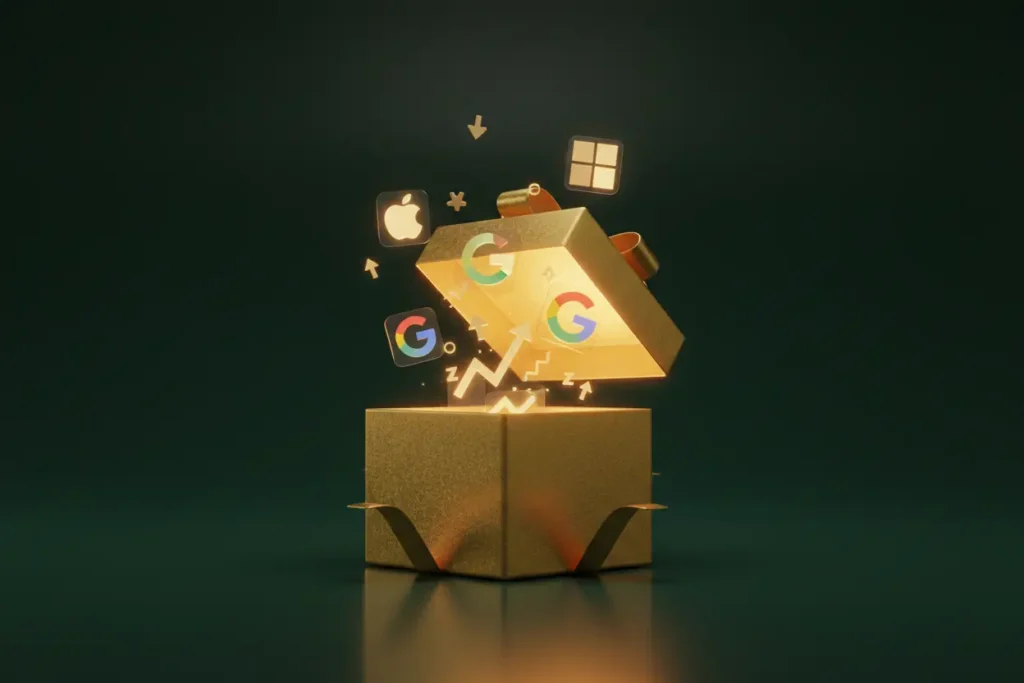
ETF stands for Exchange-Traded Fund. Sounds complicated, but it’s actually very simple.
An ETF is like a chocolate box. Inside that box are many investments. Stocks, sometimes bonds, sometimes both. So instead of buying one company, you buy a whole basket of companies in one click.
For example: you buy one S&P 500 ETF. That means you instantly own a small piece of the 500 biggest US companies. Apple, Microsoft, Amazon, Nvidia. All in one purchase.
Why do most investors (including myself) like ETFs? Three reasons:
- Diversification. Your money is spread across hundreds or thousands of companies. If one company struggles, the others carry the weight.
- Low cost. Most broad ETFs charge between 0.07% and 0.22% per year. Compare that to actively managed funds at Swiss banks, which often charge 1% to 2%.
- Simplicity. You buy them on a stock exchange, just like a regular stock. No paperwork, no phone calls to your bank.
Of course, ETFs aren’t perfect. You won’t beat the market with a passive ETF. And you don’t control which individual companies are included. But for most beginners, the simplicity and low cost make ETFs the best starting point.
ETF vs Index Fund vs Mutual Fund: What’s the Difference?
I’ve seen friends put a lot of money into one of these without understanding the differences. Then later, they realise it wasn’t the best choice. Switzerland has a strong tradition of bank-sold mutual funds, so it’s worth knowing your options.
Let me break it down simply.
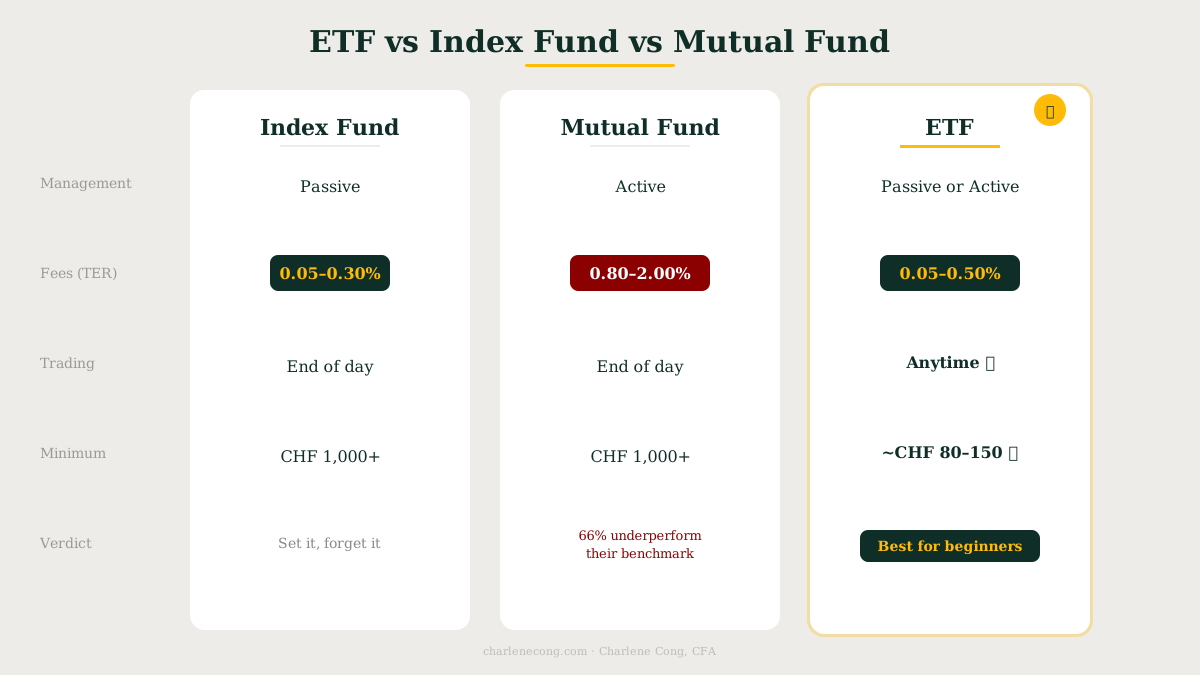
Index funds are passive. They follow a market index (like the S&P 500 or MSCI World) without trying to beat it. When the market goes up, they go up. When it goes down, they go down. No drama. I like to call them “copycats” of the investing world.
Mutual funds are actively managed. A team of professionals picks stocks, trying to outperform the index. Sounds great in theory. But here’s the problem: according to research, about 66% of equity mutual funds underperformed their benchmarks over a three-year period. You’re paying higher fees for someone who, more often than not, doesn’t deliver better results.
ETFs trade on stock exchanges throughout the day, just like individual stocks. They can be either passive or active (yes, actively managed ETFs exist). The key advantage is flexibility: you can buy and sell any time during market hours.
Here’s a quick comparison:
| Feature | Index Fund | Mutual Fund | ETF |
|---|---|---|---|
| Management | Passive | Active | Both |
| Typical fees (TER) | 0.05% – 0.30% | 0.80% – 2.00% | 0.05% – 0.50% |
| Trading | Once per day | Once per day | Any time (exchange hours) |
| Minimum investment | Often CHF 1,000+ | Often CHF 1,000+ | Price of 1 share |
| Best for | Set and forget | Belief in active mgmt | Flexibility + low cost |
My honest opinion? For most beginners in Switzerland, ETFs are the sweet spot. Low cost, easy to buy, highly flexible. That’s what I recommend to the students in my investing course in Switzerland.
How to Choose the Best ETF: 6 Criteria That Actually Matter
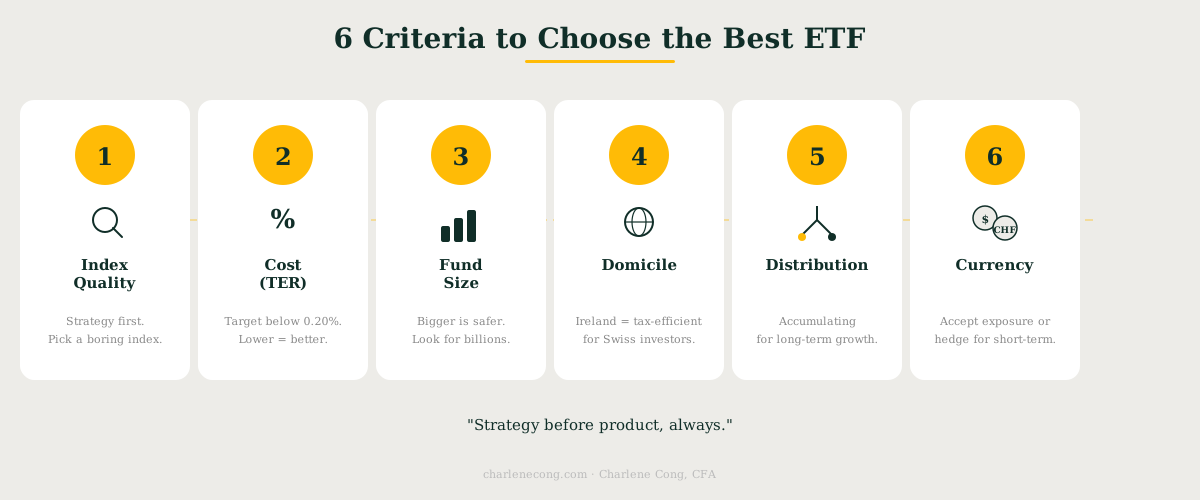
Not all ETFs are created equal. Two ETFs can look similar on the surface. But over 20 or 30 years, the differences really add up. Here are the 5 criteria I use to evaluate any ETF.
1. Index Quality (Strategy Comes First)
This is the foundation. And it’s where most people get it wrong.
An ETF is just a wrapper, like the chocolate box I mentioned earlier. What matters are the chocolates inside, meaning the index underneath.
Before asking “Is this a good ETF?” you should ask: “Does this index fit my financial situation and my goals?”
A long-term goal like retirement in 25 to 30 years? A broad global equity index makes a lot of sense. A medium-term goal like buying property in 5 to 7 years? You might want something more balanced.
For a complete overview of all investment options in Switzerland, not just ETFs, see my guide to the best investments in Switzerland.
I prefer indexes that are well-established, rules-based, transparent, and frankly, boring. Indexes like the S&P 500, MSCI World, FTSE All-World, and MSCI ACWI.
This is exactly what I teach inside my VISION Academy course: strategy before product, always.
2. Cost (TER)
Fees matter more than most people think.
The TER (Total Expense Ratio) is the annual fee you pay to hold the ETF. Every year, no matter what. A TER of 0.20% might sound tiny. But over 30 years on a large portfolio, it adds up to thousands of francs.
For core ETFs, I generally look for a TER below 0.20%. Below 0.10% is even better. Remember: high fees don’t mean higher returns. They just mean more money going to the fund provider instead of staying in your pocket.
Practical tip: a 1% difference in annual fees on a CHF 200,000 portfolio costs you over CHF 50,000 across 25 years. Always check the TER before buying.
3. Fund Size (AUM)
A good ETF should have a decent amount of assets under management (AUM). Ideally hundreds of millions, or even better, billions.
Why does this matter? Larger ETFs mean better liquidity (easier to buy and sell), tighter bid-ask spreads (smaller gap between buy and sell price), and lower risk of the ETF being shut down.
Small ETFs can be more expensive to trade. Worse, they can be shut down by the provider if they don’t attract enough investors. That’s a risk you don’t need as a beginner.
4. Domicile
ETF domicile means where the fund is legally based. As a Swiss investor, you’ll mainly see two options:
- US-domiciled ETFs: Very low fees, excellent liquidity, great for US stock exposure. Withholding tax on US dividends can usually be reclaimed in Switzerland.
- Ireland-domiciled ETFs: Better tax treatment for non-US stocks, less dividend tax leakage for global exposure. Often the preferred choice for world or all-world strategies.
There’s no universally “best” domicile. It depends on what you invest in. For US-focused strategies, US-domiciled ETFs can work well. For global strategies, Ireland-domiciled ETFs often make more sense from a tax perspective.
5. Distribution Type: Accumulating vs Distributing
ETFs handle dividends in two ways:
- Distributing: Pays dividends to your brokerage account as cash. You decide what to do with it.
- Accumulating: Automatically reinvests dividends back into the fund. Your investment compounds without you lifting a finger.
In Switzerland, both types are taxed on dividends. This surprises many beginners. Even with accumulating ETFs, the tax office uses a notional (theoretical) dividend figure to calculate your tax. So the tax treatment is essentially the same.
For long-term wealth building, I generally prefer accumulating ETFs. They remove the temptation to spend the dividends and they compound automatically. But if you like seeing cash hit your account, distributing works too.
6. Currency
When you buy an ETF, you’re exposed to the currency it trades in.
A US-focused ETF in USD means your returns depend on both stock performance and the USD/CHF exchange rate. If the S&P 500 rises 10% but the dollar weakens 5% against the franc, your actual return in CHF is closer to 5%.
For Swiss investors, three options:
- Accept the exposure. Long-term investors often view currency swings as noise that balances out over decades.
- Choose CHF-hedged ETFs. These reduce exchange rate impact but come with extra costs, both in fees and in lost yield from interest rate differences between USD and CHF.
- Diversify globally. A world ETF naturally spreads exposure across USD, EUR, JPY, GBP, and other currencies.
My approach? For long-term goals (10+ years), I accept the currency exposure. Research shows no evidence that hedging improves returns for long-term Swiss investors. For shorter-term goals like a property down payment, currency risk becomes more relevant, so a hedged option might make sense.
Best ETFs for Beginners in Switzerland (2026)
Based on the criteria above, here are some examples of ETFs that meet these standards. These are not recommendations or financial advice. I’m sharing them as illustrations to help you understand what to look for when doing your own research.
| ETF Name | Index | TER | Domicile | Type |
|---|---|---|---|---|
| iShares Core MSCI World UCITS ETF (Acc) | MSCI World | 0.20% | Ireland | Accumulating |
| Vanguard S&P 500 UCITS ETF (Acc) | S&P 500 | 0.07% | Ireland | Accumulating |
| Vanguard FTSE All-World UCITS ETF (Acc) | FTSE All-World | 0.22% | Ireland | Accumulating |
| UBS ETF MSCI World UCITS ETF (USD) A-acc | MSCI World | 0.10% | Ireland | Accumulating |
| iShares Core S&P 500 UCITS ETF (Acc) | S&P 500 | 0.07% | Ireland | Accumulating |
| iShares Core MSCI Europe UCITS ETF (Acc) | MSCI Europe | 0.12% | Ireland | Accumulating |
| iShares Core MSCI EM IMI UCITS ETF (Acc) | MSCI EM IMI | 0.18% | Ireland | Accumulating |
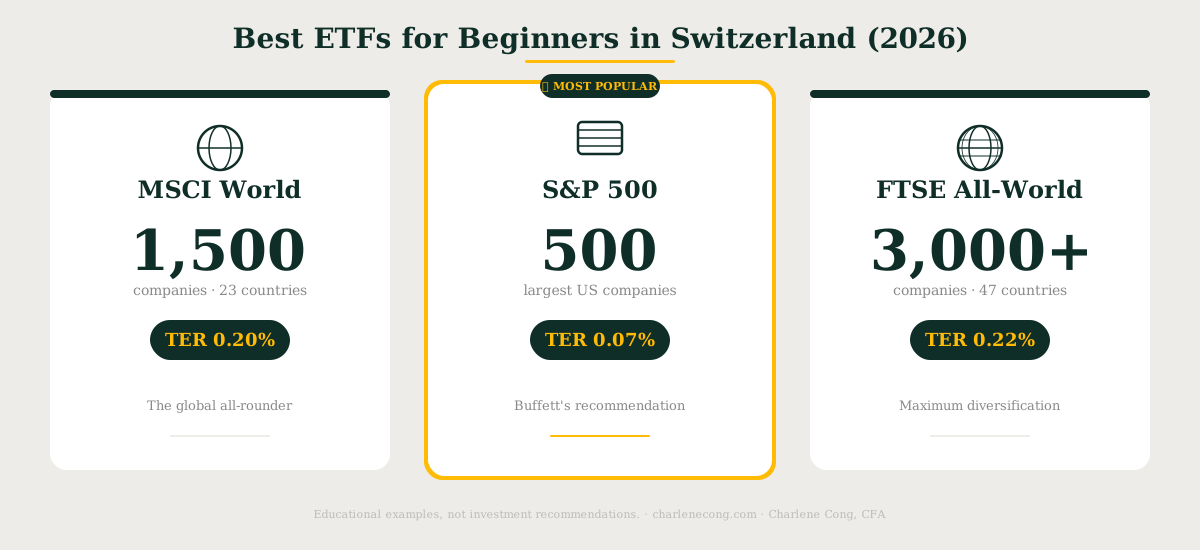
Let me explain the three main choices:
MSCI World ETF
Tracks around 1,500 companies from 23 developed countries. The US makes up roughly 70%, followed by Japan, the UK, and Europe. This is the classic “one ETF portfolio” choice for global diversification.
S&P 500 ETF (Vanguard)
Tracks the 500 largest US companies. It’s arguably the most popular index in the world. If I had to pick one investment that stands out as the most powerful wealth builder in market history, it would be the S&P 500.
The Vanguard S&P 500 ETF (VOO) charges just 0.07% per year. That means CHF 7 per year for every CHF 10,000 invested. Practically nothing.
I’ve made a detailed video on how to buy VOO step by step. You can find it on my YouTube channel.
FTSE All-World ETF
Want the broadest diversification possible? The FTSE All-World covers over 3,000 companies from both developed and emerging markets (China, India, Brazil, etc.). It’s the “everything in one” approach.
Practical tip: you don’t need 10 ETFs. You don’t even need 5. For a beginner, one broad ETF is a perfectly valid portfolio. You can always add more as you learn and grow.
How to Buy Your First ETF in Switzerland
This is where many beginners freeze. They research for weeks, compare every detail, and never actually invest. I see it all the time. Don’t be that person.
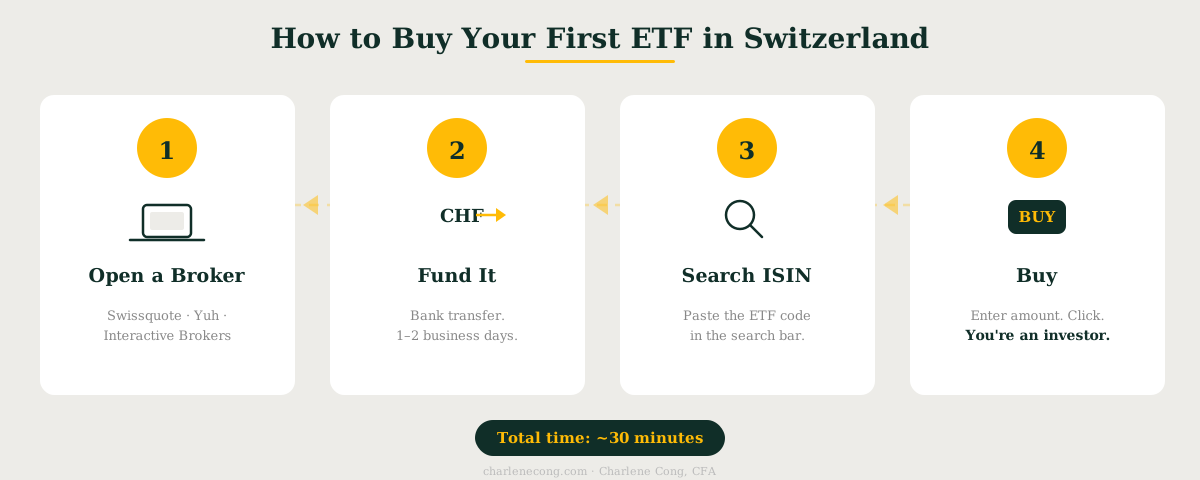
Here’s the process in 4 simple steps.
Step 1: Open a brokerage account. You need a broker to buy ETFs. Three solid options for Swiss investors:
- Swissquote: The largest Swiss online broker. Wide ETF selection, reliable, based in Switzerland.
- Saxo: Competitive fees starting at CHF 3 per trade, no custody fees since 2025, FINMA-regulated.
- Interactive Brokers: Lowest trading fees. Best for those comfortable with a more complex interface.
Step 2: Fund your account. Transfer money from your Swiss bank. This usually takes 1 to 2 business days.
Step 3: Search for your ETF. Use the ISIN number (the ETF’s unique identifier) to find it in your broker’s search. Here are some examples of popular ETFs (for illustration purposes only):
- MSCI World (iShares Acc): IE00B4L5Y983
- S&P 500 (Vanguard Acc): IE00BFMXXD54
- FTSE All-World (Vanguard Acc): IE00BK5BQT80
Step 4: Buy. Enter the amount. Click buy. That’s it. You’re now an investor.
The whole process takes about 30 minutes once your broker account is set up.
5 Common Mistakes Beginners Make with ETFs in Switzerland
Mistake 1: Trying to time the market. This is the biggest one. People try to guess when prices will be lowest to buy and highest to sell. Can you predict this? Trust me, no one can. Not even the professionals. If someone gets it right once, they probably won’t get it right twice, three times, or over the long term. Focus on time in the market, not timing the market. Think of it like planting a tree. The best time was 20 years ago. The second-best time is now.
Mistake 2: Expecting quick riches. The S&P 500 is a slow and steady winner. It grows over time, with ups and downs along the way. It’s not a place for quick profits. Think of it like a slow cooker: it takes time, but the results are worth it. If you ask Warren Buffett what the best holding period is, his answer is forever.
Mistake 3: Panicking during market drops. In March 2020, the S&P 500 dropped 30% in less than one month because of Covid-19. If you had CHF 100,000 invested, you suddenly only had CHF 70,000 on screen. I was panicking too, if I’m honest. A large portion of my investments were in VOO. News headlines were screaming about a financial crisis. But I didn’t sell. Instead, I bought more shares. After March, the market recovered immediately and went higher and higher, benefiting those who stayed patient.
Mistake 4: Overcomplicating it. Some beginners try to build a portfolio of 8 or 10 ETFs right away. That’s unnecessary. I know people who spend months comparing every possible ETF, every fee structure, every tiny detail. Some of them know more than me about which ETF has the lowest TER. Yet they still haven’t invested a single franc. Start with one broad ETF. Add complexity later as you learn more.
Mistake 5: Forgetting about Pillar 3a. If you live and work in Switzerland, Pillar 3a is one of the most powerful tax-advantaged investment tools available to you. In 2026, you can contribute up to CHF 7,258 and deduct it from your taxable income. Providers like VIAC, Finpension, and Frankly let you invest your 3a money in ETF-based portfolios with very low fees. Don’t leave free tax savings on the table.
FAQ: ETF Investing in Switzerland
How much money do I need to start investing in ETFs in Switzerland?
You can start with the price of a single ETF share. For many popular ETFs, that’s around CHF 80 to CHF 150. Some brokers allow fractional investing, so you can start with even less. The important thing is to start, not to wait until you have a large amount.
Are ETFs safe?
ETFs are diversified, which reduces risk compared to buying individual stocks. However, they still carry market risk. If the overall market drops, your ETF will drop too. The key is to invest with a long time horizon (ideally 7+ years) and not to invest money you’ll need soon.
Do I pay tax on ETFs in Switzerland?
In Switzerland, capital gains from private investments are generally tax-free. This is a huge advantage compared to most other countries. However, dividends (including notional dividends from accumulating ETFs) are taxed as income. Your ETF holdings are also included in your wealth tax calculation.
Should I buy accumulating or distributing ETFs?
Both are valid. Accumulating ETFs reinvest dividends automatically, which is convenient for long-term growth. Distributing ETFs pay dividends to your account as cash. In Switzerland, the tax treatment is similar for both. For building wealth over time, I generally lean towards accumulating ETFs.
How often should I invest?
Monthly investing is a popular and effective approach. It’s called dollar-cost averaging (or franc-cost averaging, in our case). You invest a fixed amount each month regardless of what the market is doing. This removes emotion from the equation and smooths out the ups and downs over time.
What is the difference between an ETF and an index fund?
They’re very similar. Both typically track an index passively. The main difference is that ETFs trade on stock exchanges throughout the day (like stocks), while index funds are priced and traded only once per day. For most retail investors in Switzerland, ETFs offer more flexibility and are easier to access through online brokers.
Start with One ETF. That’s All It Takes.
I want to be honest with you. I started with just $500 in one ETF during my final year of university. I didn’t have a finance background. I had no sophisticated strategy. I just knew I needed to start somewhere.
That single decision put everything in motion. Over time, through consistent monthly investing and a clear strategy, the portfolio grew to 7 figures.
You don’t need to be an expert. You don’t need CHF 50,000 in savings. You need one ETF and the discipline to invest a little each month.
The incremental move from not doing anything to doing something? That’s huge. If you’ve never invested and you start with one simple ETF, that’s a game changer.
Ready to build your full investment strategy?
If this guide helped you understand ETFs and you want to go further, I’d love to invite you to my free live investment masterclass. In 90 minutes, I’ll walk you through the exact framework I used to build my portfolio and retire at 32. No sales pressure. Just real education.
Ready to Learn Investing in Switzerland the Right Way?
If you’re ready to dive deeper into investing money in Switzerland, I’d love to invite you to my free live investment masterclass.
In this 90-minute workshop, I’ll show you exactly how I built a 7-figure investment portfolio — and how you can do it too, step by step.
You’ll learn:
- The exact framework I used to retire at 32
- All the investment options in Switzerland explained simply
- Swiss-specific tax optimization strategies
- How to make your first investment in Switzerland with confidence
Disclaimer: This article is for educational purposes only and does not constitute investment advice or financial recommendations. All investments carry risk, and past performance is not indicative of future results. This content does not account for your specific financial situation. Consult a qualified financial advisor before making investment decisions. The author is a CFA charterholder providing educational content, not regulated financial services.
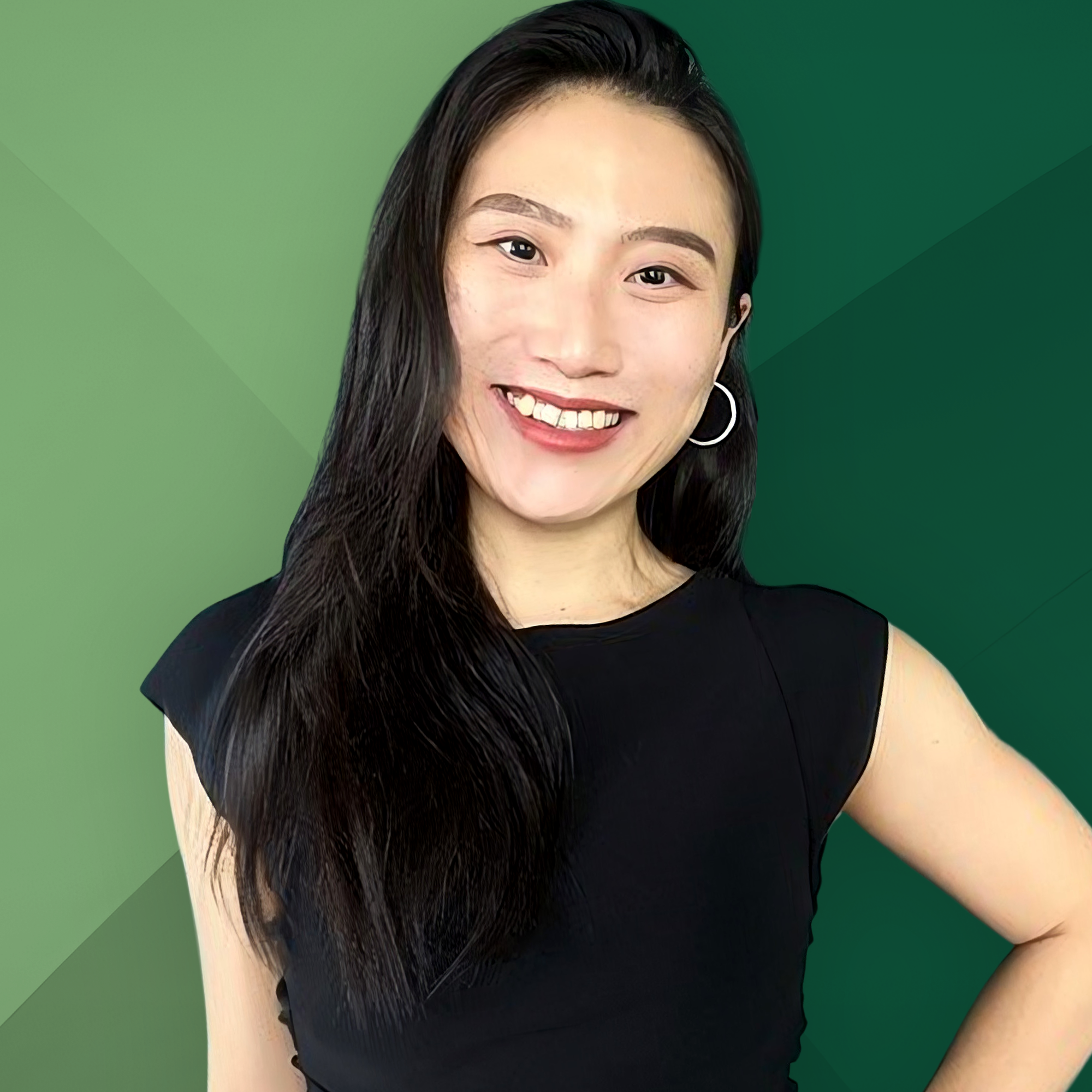
Charlene Cong, CFA, based in Zurich, Switzerland, is the founder of FinFit Solution and VISION Investment Academy. She is a seasoned Chartered Financial Analyst (CFA) with over a decade of experience in finance and banking across Asia and Europe.
Her career includes a notable tenure at JPMorgan and serving as an executive board member of the Swiss Capital Market Forum Association. She also has over seven years of experience as a banking journalist, where she investigated the investment strategies of high-net-worth individuals.