How is investment income taxed in Switzerland? Capital gains from stocks and ETFs are tax-free for private investors in Switzerland. However, dividends are taxed as income. To optimize your Swiss investment taxes, focus on growth-oriented investments over dividend stocks, maximize your Pillar 3a contributions (CHF 7,258 in 2025), and choose tax-efficient ETF domiciles. The key is staying classified as a private investor, not a professional trader.
Most expats are shocked when they learn this: capital gains from your investments are completely tax-free in Switzerland.
You buy an ETF at CHF 10,000. You sell it years later at CHF 15,000. That CHF 5,000 profit? Yours to keep. No capital gains tax. This is one of the biggest advantages of investing as a Swiss resident.
But there’s a catch. Capital gains are tax-free, yes. Dividends are taxed as income. And if you’re not careful, you could accidentally trigger taxes you never expected.
After 10 years in banking, including roles at JPMorgan and Avaloq, and building a 7-figure investment portfolio, I’ve learned the Swiss tax system inside and out. I recently sat down with Kevin Waltz, a tax advisor with 15 years of experience in Swiss taxation, to dig even deeper into what most expats get wrong.
How Swiss Investment Tax Works
Switzerland’s tax system is unique. Unlike most countries with a single national tax, Switzerland operates on three levels: federal, cantonal, and municipal. Each of the 26 cantons has its own tax laws, rates, and deductions.
But when it comes to investment income, the rules are surprisingly straightforward.
What Is Taxed vs What Is Tax-Free
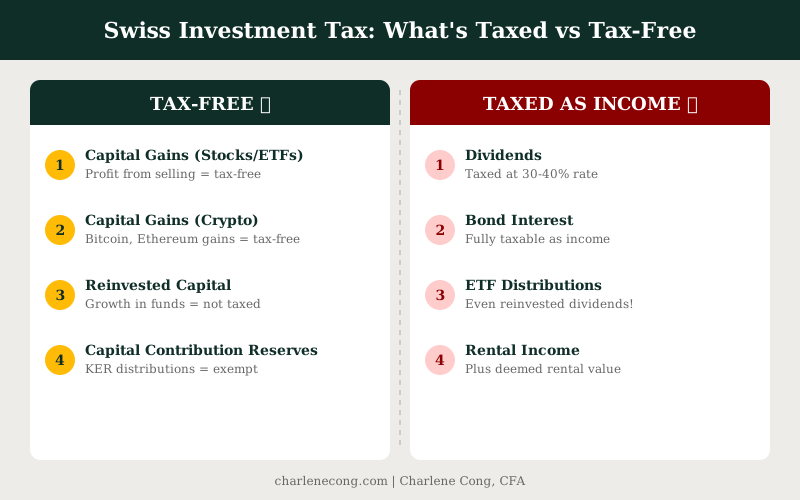
| TAX-FREE ✓ | TAXED AS INCOME ✗ |
|---|---|
| • Capital gains from stocks/ETFs • Capital gains from crypto • Reinvested capital in funds • Capital contribution reserves |
• Dividends from stocks • Interest from bonds • Distributions from ETFs/funds • Rental income from property |
The Withholding Tax Surprise
When you receive dividends from Swiss companies, 35% is automatically withheld as withholding tax. This shocks many new investors. Seeing a third of your dividend disappear feels painful.
The good news? You can claim this back in full when you file your tax return. The 35% is essentially a security deposit, not a final tax. As long as you declare your dividends correctly, you get it all back.
For foreign dividends, there’s usually a withholding tax from the country of origin, often 15% under double taxation agreements. You can reclaim part of this through your Swiss tax return using the DA-1 form.
Wealth Tax: The Hidden Annual Cost
Unlike most countries, Switzerland also has a wealth tax. Every year, you pay a small percentage on your total net assets, including bank accounts, investments, and property.
The rate varies by canton, typically between 0.1% and 1.0%. For most investors, this is a minor cost. But it’s something to factor into your long-term planning, especially as your portfolio grows.
The “Professional Trader” Trap
This is where many investors unknowingly get into trouble.
Capital gains are tax-free for private investors. But they become fully taxable if the tax authorities classify you as a professional trader.
The Swiss Federal Tax Administration looks at five criteria. You don’t need to meet all five. Even triggering two or three could raise red flags:
| 1 | Leverage: You use borrowed money (margin/loans) to finance your investments. |
| 2 | High turnover: Your buy/sell volume exceeds 5x your portfolio value per year. |
| 3 | Capital gains dominance: More than 50% of your income comes from capital gains. |
| 4 | Short holding periods: You hold securities for less than 6 months before selling. |
| 5 | Derivatives trading: You actively trade options/derivatives beyond simple hedging. |
If you’re a long-term, buy-and-hold investor (which I strongly recommend) you have nothing to worry about. The professional trader classification targets day traders and speculators, not people building wealth over decades.
Tax-Efficient Investment Strategies
Now that you understand how Swiss investment tax works, let me show you the strategies I use to minimize my tax burden legally.
1. Favor Growth Over Dividends
Since capital gains are tax-free but dividends are taxed, the math is simple: growth stocks beat dividend stocks for Swiss investors.
Personally, I don’t have many dividend-focused stocks. Even when I receive dividends, I reinvest them back into the market. The math is simple: every franc of dividends gets taxed at your marginal income tax rate, which could be 30-40% depending on your canton. Capital appreciation? Zero tax.
This doesn’t mean you should avoid all dividends — diversification matters. But if tax efficiency is a priority, tilting toward growth makes sense.
2. Choose Tax-Efficient ETF Domiciles
Where your ETF is domiciled matters more than most people realize.
| ETF Domicile | US Dividend Withholding | Best For |
|---|---|---|
| US-domiciled | 15% (with W-8BEN) | US investors |
| Ireland-domiciled | 15% | Swiss investors ✓ |
| Switzerland-domiciled | 35% (reclaimable) | Swiss market exposure |
For most Swiss investors, Irish-domiciled ETFs (like those from iShares or Vanguard Europe) are the sweet spot. They benefit from Ireland’s favorable tax treaty with the US while avoiding the complexity of US tax forms. For specific recommendations, check out my guide on the best ETFs for beginners in Switzerland.
3. Accumulating vs Distributing ETFs
A common misconception: “If I choose an accumulating ETF that reinvests dividends, I avoid dividend tax.”
This is not true in Switzerland. Even if dividends are reinvested within the fund, you still owe tax on them. The fund reports the reinvested income to the Swiss tax administration, and you must declare it.
Accumulating ETFs are still simpler to manage since you don’t need to manually reinvest distributions. Just know that tax-wise, it makes little difference.
Pillar 3a: The Ultimate Tax Shelter
If there’s one tax optimization every Swiss investor should use, it’s Pillar 3a. This private pension account is the most powerful legal tax shelter available.
How It Works
Every franc you contribute to Pillar 3a is deducted from your taxable income. In 2025, the maximum contribution is CHF 7,258 if you have a pension fund (Pillar 2), or up to CHF 36,288 if you’re self-employed without one.
The tax savings are immediate and significant. Depending on your canton and income, contributing the maximum could save you CHF 1,500-2,500 in taxes every year.
My Pillar 3a Strategy
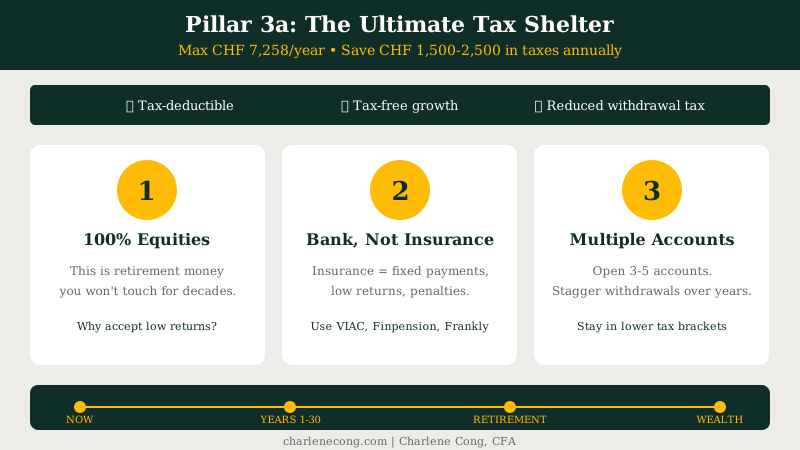
1. Invest 100% in equities. This is retirement money you won’t touch for decades. Why keep it in a low-interest savings account? I invest my Pillar 3a entirely in equity funds. The growth is tax-free while inside the account. If you’re new to investing, start with my guide on how to start investing in Switzerland.
2. Use a bank or investment platform, not an insurance company. Insurance-based Pillar 3a products lock you into fixed monthly payments with low returns and heavy penalties if you need to withdraw early. Bank-based solutions like VIAC, Finpension, or Frankly are far more flexible and transparent.
3. Open multiple accounts. When you retire, withdrawals from Pillar 3a are taxed at a reduced rate. But if you withdraw everything at once, you hit a higher tax bracket. By spreading your savings across multiple accounts, you can stagger withdrawals over several years and minimize the tax impact.
Deductions Most Expats Miss
When I spoke with tax advisor Kevin Waltz, he emphasized that the most common mistake is simply forgetting to claim deductions you’re entitled to. The tax authorities won’t add them for you.
Commuting Costs
You can deduct the cost of getting to work, whether by public transport or car. The federal limit is around CHF 3,000, but some cantons allow more. If you commute from Zug to Zurich for the tax savings, make sure you’re capturing this deduction.
Meal Deductions
For each workday, you can typically deduct CHF 15 for meals. No receipts required. This is a “lump sum” deduction that many expats overlook. Over a year, it adds up.
Home Office Costs
If your employer doesn’t provide a workspace, you may be able to deduct part of your rent, utilities, and furniture. This became especially relevant after COVID normalized remote work.
Professional Development
Courses, certifications, and further education to advance your career are often deductible. This includes tuition fees, books, and exam costs. If you’re pursuing a CFA, MBA, or professional certification, keep those receipts.
Foreign Tax Reclaims
If you receive dividends from foreign investments, there’s usually withholding tax from the country of origin. Many expats forget to claim this back. Use the DA-1 form to credit foreign withholding taxes against your Swiss tax liability.
When to DIY vs Hire a Tax Advisor

This might surprise you: even though I’m a CFA with a background in banking, I use a tax advisor.
Why? Time is money.
A good tax advisor is more efficient than me at navigating the forms, deadlines, and cantonal quirks. They save me hours every year, hours I can spend on things that matter more. And they often find deductions I would miss.
DIY if: Your situation is simple (single income source, no property, straightforward investments). Use online tools like the cantonal tax software.
Hire a professional if: You’re new to Switzerland, have multiple income sources, own property, have stock options/RSUs, or simply value your time more than the cost of an advisor.
Kevin Waltz recommends that expats get professional help for at least their first tax return. You’ll learn what deductions are possible, and you can copy the approach in subsequent years.
Ready to Build a Tax-Efficient Portfolio?
Understanding taxes is just one piece. The real question is: what is your investment strategy? Join my free 90-minute live masterclass where I share the exact framework I used to build a 7-figure portfolio and retire at 32.
FAQ: Swiss Investment Tax
Do I pay tax on capital gains in Switzerland?
No, private investors do not pay capital gains tax on stocks, ETFs, or crypto in Switzerland. This is one of the biggest tax advantages of investing here. However, if you are classified as a professional trader, capital gains become taxable.
Are dividends taxed in Switzerland?
Yes. Dividends are taxed as ordinary income at your marginal tax rate. Swiss dividends have 35% withheld automatically, but you can reclaim this when you file your tax return.
What is the DA-1 form?
The DA-1 form allows Swiss residents to credit foreign withholding taxes against their Swiss tax liability. If you receive dividends from US or European stocks, you can use this form to reclaim some of the foreign tax withheld.
Is Pillar 3a worth it?
Absolutely. Pillar 3a contributions are tax-deductible, the growth inside is tax-sheltered, and withdrawals are taxed at a reduced rate. It is the single most effective tax optimization tool available to Swiss residents.
Should I choose accumulating or distributing ETFs?
In Switzerland, the tax treatment is essentially the same — dividends are taxable whether distributed or reinvested. Choose based on convenience. Accumulating ETFs are simpler if you want automatic reinvestment.
When should I file my Swiss tax return?
The standard deadline is March 31 for the previous tax year. Most cantons allow extensions if you request them before the deadline. Some cantons (like Zug) are flexible; others (like Zurich) are stricter about extensions.
Do expats always need to file a tax return?
Not always. If you have a B permit and earn under CHF 120,000, taxes may be withheld at source without a return. But if your income exceeds CHF 120,000, you own property, or you have significant wealth, you must file. When in doubt, contact your cantonal tax authority.
Disclaimer: This article is for educational purposes only and does not constitute tax or investment advice. Tax laws vary by canton and individual situation. Consult a qualified tax advisor for personalized guidance.

Charlene Cong, CFA, based in Zurich, Switzerland, is the founder of FinFit Solution and VISION Investment Academy. She is a seasoned Chartered Financial Analyst (CFA) with over a decade of experience in finance and banking across Asia and Europe.
Her career includes a notable tenure at JPMorgan and serving as an executive board member of the Swiss Capital Market Forum Association. She also has over seven years of experience as a banking journalist, where she investigated the investment strategies of high-net-worth individuals.