When I first moved to Switzerland, I had no idea where to start. I had money sitting in a UBS savings account earning basically nothing, a stack of confusing paperwork about something called “Pillar 3a,” and zero clue whether my Permit B even allowed me to invest.
Sound familiar?
I spent 10 years in banking, including roles at JPMorgan and Avaloq, and built a 7-figure investment portfolio along the way. I’ve helped hundreds of expats navigate exactly this confusion. The Swiss financial system isn’t complicated once you understand how the pieces fit together. By the end of this guide, you’ll have a clear roadmap: which accounts to open, in what order, and exactly how to start investing.
Can expats invest in Switzerland? Yes. Permit B and C holders face no restrictions on investing in stocks, ETFs, or cryptocurrency. To start: open a Pillar 3a account first (could save you CHF 1,500-2,500 in taxes annually), then a low-cost broker like Interactive Brokers, Swissquote, or Saxo. Capital gains are completely tax-free for private investors in Switzerland. This makes it one of the most attractive places in the world to build wealth.
Can Expats Invest in Switzerland? The Permit B Truth

Let’s clear this up immediately: yes, you can invest freely in Switzerland with a Permit B.
I’ve heard this question hundreds of times, and the confusion is understandable. Switzerland has strict rules about many things. But investing in financial markets isn’t one of them. Whether you’re holding a Permit B, C, or even an L permit, you can open a brokerage account, buy stocks and ETFs, invest in cryptocurrency, and contribute to Pillar 3a.
The only real restriction? Property. With a Permit B, you can buy a home to live in, but you cannot purchase investment properties to rent out. That requires a C permit. For stocks, ETFs, and pension accounts, you’re completely free.
| Investment Type | Permit B | Permit C |
|---|---|---|
| Stocks and ETFs | ✓ No restrictions | ✓ No restrictions |
| Pillar 3a | ✓ Full access | ✓ Full access |
| Cryptocurrency | ✓ No restrictions | ✓ No restrictions |
| Primary residence | ✓ Can purchase | ✓ Can purchase |
| Investment property (rental) | ✗ Not allowed | ✓ Allowed |
One thing to understand about taxes: if your annual income is below CHF 120,000, your taxes are deducted at source automatically (e.g., in Zurich). You don’t need to file a tax return unless you want to claim additional deductions. Above CHF 120,000, you must file a return and declare your investments. Either way, you still need to declare dividends and wealth if you’re filing. But your investment gains remain tax-free.
Your First Year Roadmap
When you’re new to Switzerland, everything feels urgent. But there’s an optimal sequence that most expats miss. Follow this timeline, and you’ll set yourself up correctly from day one.
Month 1-2: Open Your Bank Account
You need a Swiss bank account for your salary. Don’t overthink this. For most expats, a digital bank like Neon or Yuh works perfectly. No monthly fees, free debit card, and a clean mobile app. If you need mortgage services or prefer in-person banking, ZKB or UBS are solid traditional options, though you’ll pay CHF 5-8 per month.
One thing to note: some digital banks may require your residence permit to be fully issued before opening an account. If you’re still waiting for your permit, traditional banks like UBS or ZKB are often more flexible with the documentation they accept.
Month 2-3: Open Pillar 3a Immediately
This is where most expats leave money on the table. Every franc you contribute to Pillar 3a is deducted from your taxable income. In 2026, you can contribute up to CHF 7,258 if you’re employed. Depending on your canton and income, that’s CHF 1,500-2,500 back in your pocket at tax time. The sooner you start, the more tax years you benefit from.
Even if you arrive in November, contribute the maximum for that year. You have until December 31st to make contributions that count for the current tax year. Many expats miss their first year entirely because they don’t realize the deadline.
Month 3-6: Open Your Broker Account
Once your emergency fund is in place and Pillar 3a is running, it’s time to open a brokerage account for taxable investing. I recommend Interactive Brokers for most people. The fees are extremely low and you get access to global markets. If you prefer a Swiss-regulated option, Saxo Bank or Swissquote are good alternatives.
The account opening process takes a few days to 1-2 weeks. You’ll need to provide ID, proof of address, and answer questions about your investment experience. Start the process before you’re ready to invest so everything is set up when you have funds to deploy.
Month 4+: Make Your First Investment
Start simple. One global ETF like Vanguard Total World (VT) or VWRL gives you exposure to over 9,000 companies worldwide. You don’t need a complex portfolio when you’re starting out. Complexity can come later.
For your first investment, don’t try to time the market. Pick a day, whether that’s the 1st of the month or your payday, and invest. The best time to start was yesterday. The second best time is today.
Ongoing: Automate Everything
Set up automatic monthly transfers to your Pillar 3a and broker. Automation removes emotion from investing. You’ll invest consistently whether the market is up, down, or sideways. And that consistency is exactly what builds wealth over decades.
I transfer money to my broker on the same day each month. I don’t check prices, I don’t think about whether it’s a “good time.” I just invest. This approach has served me better than any market timing strategy ever could.

The Swiss Pension System in 5 Minutes
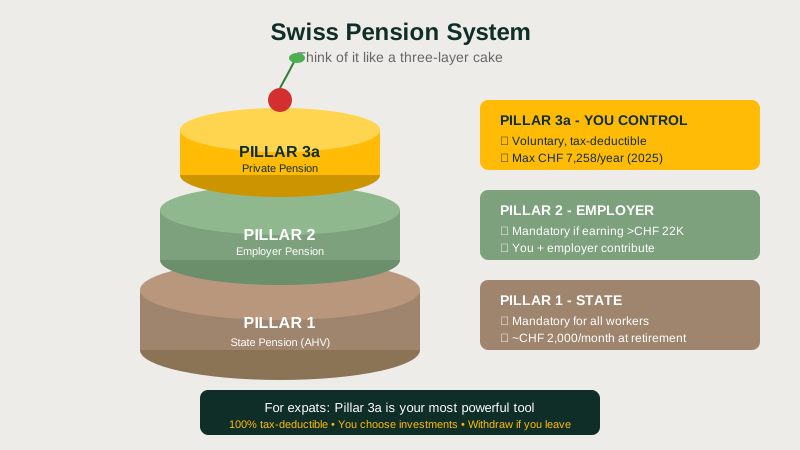
Think of the Swiss pension system like a three-layer cake. Each layer serves a different purpose, and together they’re designed to replace about 60-70% of your pre-retirement income.
Pillar 1 (AHV/AVS) is the state pension. It’s mandatory for everyone working in Switzerland. You and your employer each contribute about 4.35% of your salary. When you retire, you’ll receive roughly CHF 2,000 per month, if there’s no gap in contributions. Enough to survive, but not to thrive.
Pillar 2 (BVG/LPP) is your occupational pension through your employer. If you earn more than CHF 22,050 per year, your employer must provide this. Both you and your employer contribute, and the money is invested until retirement. This is typically the largest chunk of your retirement savings.
Pillar 3a is your private pension, and it’s the one you control completely. Contributions are voluntary but tax-deductible. The growth inside is tax-sheltered. And when you withdraw at retirement, it’s taxed at a reduced rate. For expats, Pillar 3a is often the single most powerful financial tool available.
| Feature | Pillar 1 | Pillar 2 | Pillar 3a |
|---|---|---|---|
| Mandatory? | Yes | Yes (if >CHF 22K) | No |
| Tax deductible? | Yes (automatic) | Yes (automatic) | Yes (up to CHF 7,258) |
| You control investments? | No | No | Yes |
| Can withdraw if leaving CH? | Depends on destination | Yes (restrictions for EU) | Yes (full amount) |
| Payout at retirement | ~CHF 2,000/month | Lump sum or annuity | Lump sum only |
Where to Open Accounts
Choosing the right accounts will save you thousands over your investing lifetime. The wrong choices, especially with Pillar 3a, can cost you even more.
Bank Accounts
For everyday banking, you don’t need a premium account. Digital banks have made traditional bank fees almost obsolete.
| Bank | Monthly Fee | Best For |
|---|---|---|
| Neon | CHF 0 | Most expats ✓ |
| Yuh | CHF 0 | Investing + banking combo |
| ZKB | CHF 5 | In-person service, mortgages |
| UBS | CHF 5-8 | Full-service, business accounts |
Pillar 3a Providers
This is where the biggest trap exists. Insurance companies will approach you with “Pillar 3a” products that lock you into 10-20 year contracts with heavy penalties for early withdrawal. Don’t sign these.
Instead, use a bank-based Pillar 3a that lets you invest in low-cost funds with no lock-in:
| Provider | Total Fee (TER) | Max Equity Allocation |
|---|---|---|
| Finpension | 0.39% | 99% |
| VIAC | 0.40% | 97% |
| Frankly | 0.45% | 95% |
I invest my Pillar 3a 99% in equities. This is retirement money I won’t touch for decades, so there’s no reason to keep it in bonds or savings accounts earning almost nothing.
Broker Accounts
The difference between Swiss brokers and international brokers is staggering. A single trade at a traditional Swiss bank can cost CHF 50-100. The same trade at Interactive Brokers costs CHF 1-2.
| Broker | Trade Cost (CHF 10K) | Custody Fee |
|---|---|---|
| Interactive Brokers | ~CHF 1-2 | CHF 0 |
| Saxo Bank | ~CHF 3-5 | CHF 0 |
| Swissquote | ~CHF 20-50 | CHF 20-50/quarter |
| UBS | ~CHF 50-100 | 0.2-0.5%/year |
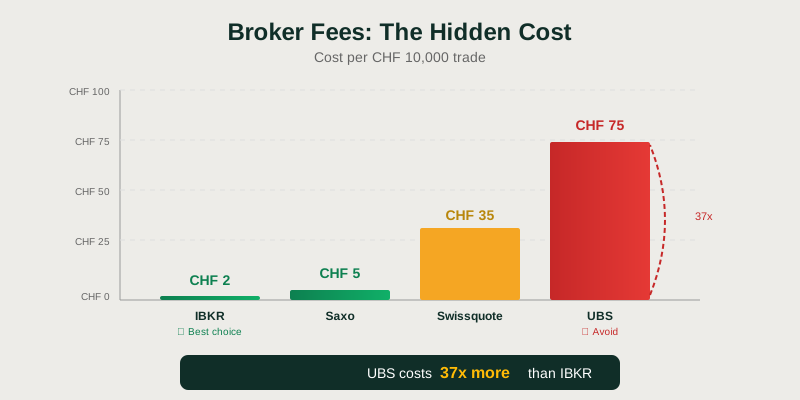
Interactive Brokers and Swissquote are what I use for my personal portfolio. The interface takes some getting used to, but the savings compound enormously over time.
What to Actually Invest In
When I started investing, I thought I needed to pick individual stocks and build a complex portfolio. I was wrong. The simplest approach is often the best.
For most expats, a single global ETF and a bond fund could be enough to start. Vanguard Total World (VT) holds over 9,000 companies across developed and emerging markets. One fund, instant diversification, done.
If you want a European-listed alternative, Vanguard FTSE All-World (VWRL) does essentially the same thing. The choice between US-listed (VT) and Irish-listed (VWRL) comes down to tax efficiency.
For Swiss investors, Irish-domiciled ETFs are typically the sweet spot. They benefit from Ireland’s favorable tax treaty with the US (15% dividend withholding instead of 30%) while avoiding the complexity of US estate tax rules. For specific fund recommendations based on your situation, check out my guide to the best ETFs for beginners in Switzerland.
My portfolio is simple: 80% global stocks (VT), 20% Swiss stocks (CHSPI). That’s it. Complexity doesn’t equal better returns.
Tax Basics for Expat Investors
Switzerland has one of the most investor-friendly tax systems in the world. Understanding it takes five minutes and can save you from unnecessary worry.
Capital gains are tax-free. Buy a stock at CHF 10,000, sell it at CHF 20,000, and that CHF 10,000 profit is yours. No capital gains tax. This is one of Switzerland’s biggest advantages for investors.
Dividends are taxed as income. Any dividends you receive are added to your taxable income and taxed at your marginal rate. This is why growth-oriented investing can be more tax-efficient than dividend-focused strategies.
Swiss dividends have 35% withheld. This shocks many new investors. But don’t panic. You can claim it back in full when you file your tax return. It’s essentially a security deposit, not a final tax.
Foreign dividends have 15% withheld (for US stocks under the tax treaty). You can reclaim some of this using the DA-1 form when filing your Swiss taxes.
Wealth tax exists. Switzerland taxes your net worth annually at rates between 0.1% and 1% depending on your canton. For most people, this is a minor cost. But it’s worth factoring into long-term planning.

7 Mistakes That Cost Expats Thousands
I’ve seen these mistakes over and over. Each one is avoidable if you know what to watch for.
1. Signing a Life Insurance Pillar 3a
Insurance salespeople target expats aggressively. Their Pillar 3a products lock you into contracts for 10-20 years with penalties up to 50% if you leave early. The returns are poor, the fees are high, and you lose flexibility. Use a bank-based provider like Finpension or VIAC instead.
2. Using Traditional Swiss Banks for Investing
UBS, or previously Credit Suisse, and other traditional Swiss banks charge management fees of 1-2% per year plus transaction costs. Over 30 years, that difference compounds to hundreds of thousands of francs. Use a low-cost broker.
3. Not Maxing Your Pillar 3a
Every year you don’t contribute the maximum CHF 7,258, you lose CHF 1,500-2,500 in tax savings permanently. You can’t go back and contribute for previous years. Start immediately, even if it’s just CHF 200 per month.
4. Leaving Money in Savings Accounts
Swiss savings accounts pay essentially 0% interest. Inflation erodes your purchasing power every year. Money you’ll need in 5+ years should be invested, not sitting idle.
5. Buying the Wrong ETF Domicile
Luxembourg-domiciled ETFs often have worse tax treatment than Irish-domiciled ones for Swiss investors. Check the domicile before buying. It affects your dividend taxation.
6. Waiting for the “Perfect Moment”
There’s never a perfect time to start investing. Waiting for markets to drop, waiting until you understand everything, waiting until you have “enough” money… it all costs you returns. Start with whatever you have.
7. Not Understanding the 35% Withholding Tax
Many expats see 35% withheld from Swiss dividends and assume it’s lost. It’s not. You claim it back when filing taxes. Don’t let this confusion stop you from investing in Swiss companies.
Ready to Build Your Portfolio?
Understanding the theory is one thing. Putting it into action is another. Join my free 90-minute live masterclass where I share the exact framework I used to build a 7-figure portfolio and “retire” from corporate at 32.
FAQ: Expat Investing in Switzerland
Can I invest with a Permit B in Switzerland?
Yes. Permit B holders have no restrictions on investing in stocks, ETFs, cryptocurrency, or contributing to Pillar 3a. The only restriction is on investment property. You cannot buy real estate purely for rental income with a B permit (only your primary residence).
Do I need to file taxes if I earn under CHF 120,000?
If you have a Permit B and earn under CHF 120,000, your taxes are typically withheld at source and you don’t need to file a return. However, you may choose to file if you have significant deductions (like Pillar 3a contributions) that would reduce your tax burden. Above CHF 120,000, you must file a return.
What happens to my investments if I leave Switzerland?
Your brokerage investments remain yours. You can keep them or transfer them. For Pillar 3a, you can withdraw the full amount when you permanently leave Switzerland. For Pillar 2, if you move to an EU country, you can only withdraw the over-mandatory portion; the rest stays in a vested benefits account. If you move outside the EU, you can withdraw everything.
Should I use a Swiss or foreign broker?
For most expats, a foreign broker like Interactive Brokers offers dramatically lower fees, often 10-20x cheaper than traditional Swiss banks. The tradeoff is less hand-holding and a more complex interface. If you value Swiss regulation and simplicity, Saxo Bank or Swissquote are good middle-ground options.
How much should I invest monthly?
First, max your Pillar 3a (CHF 605/month to reach the CHF 7,258 annual limit). After that, invest whatever you can afford beyond your emergency fund and monthly expenses. Even CHF 500/month invested consistently over 20 years at 7% average returns grows to over CHF 260,000. Start with what you have and increase over time.
Is Pillar 3a worth it for expats who might leave?
Absolutely. The immediate tax savings (CHF 1,500-2,500/year) are yours regardless of how long you stay. If you leave Switzerland, you can withdraw your entire Pillar 3a balance. You’ll pay a small withdrawal tax, but you’ll still come out ahead compared to not contributing. Even staying for just 2-3 years makes it worthwhile.
What’s the minimum amount to start investing?
With Interactive Brokers, there’s no minimum. You can start with CHF 100 or CHF 1,000. For Pillar 3a providers like VIAC or Finpension, you can contribute as little as CHF 100/month. The important thing is to start. You can always increase your contributions as your income grows.
Can I invest in US stocks from Switzerland?
Yes. Through Interactive Brokers, you have full access to US markets. You can buy individual US stocks or US-domiciled ETFs like VT, VOO, or VTI. You’ll need to complete a W-8BEN form to get the reduced 15% dividend withholding rate (instead of 30%). Be aware of US estate tax implications if your US holdings exceed $60,000.
Disclaimer: This article is for educational purposes only and does not constitute financial advice. Investment decisions should be based on your personal situation. Consult a qualified financial advisor for personalized guidance.

Charlene Cong, CFA, based in Zurich, Switzerland, is the founder of FinFit Solution and VISION Investment Academy. She is a seasoned Chartered Financial Analyst (CFA) with over a decade of experience in finance and banking across Asia and Europe.
Her career includes a notable tenure at JPMorgan and serving as an executive board member of the Swiss Capital Market Forum Association. She also has over seven years of experience as a banking journalist, where she investigated the investment strategies of high-net-worth individuals.