Everyone says you should buy a home in Switzerland. It feels like the ultimate goal. No more rent. More stability. Brunch on your own balcony with a view of the Alps.
But is buying actually the smart move? And can you even buy as a foreigner?
I bought an apartment by Lake Zurich last year with my partner. I hold a B permit in Switzerland and I’m from Hong Kong. So yes, foreigners can buy. But the rules are more complicated than most people think, and the financial decision is not as obvious as “rent is dead money.”
This guide covers everything: who can buy what, the real costs, the honest buy versus rent math, and the step by step process I went through. No fluff. Just the information you actually need.
Can Foreigners Buy Property in Switzerland? The Lex Koller Rules
Switzerland has a law called Lex Koller that restricts foreign property ownership. It sounds intimidating, but the rules are actually straightforward once you understand your permit category.
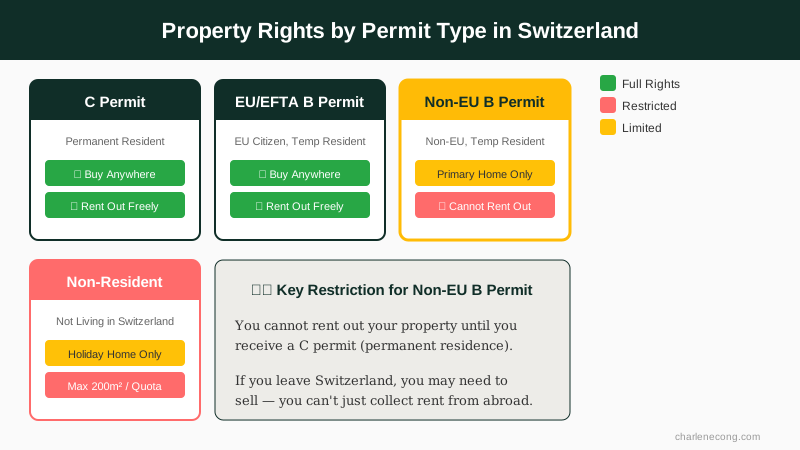
If you have a C permit (permanent residence), you have the same rights as Swiss citizens. Buy whatever you want, wherever you want, rent it out, do what you like.
If you’re an EU or EFTA citizen with a B permit, you also have full buying rights. No restrictions on property type or location.
If you’re a non-EU citizen with a B permit, like me, things get more restrictive. You can only buy a primary residence that you personally occupy. You cannot buy investment properties. And here’s the part that surprised me: you cannot rent it out until you get a C permit.
When I signed at the notary’s office, they made this point crystal clear. Everything was in German since I live in Zurich, and they went through every detail. The restriction on renting was spelled out explicitly. If I leave Switzerland before getting my C permit, I cannot just keep the apartment and collect rent. That’s a major consideration for expats who aren’t sure about their long term plans.
If you’re a non-resident (not living in Switzerland at all), your options are very limited. You can only buy holiday apartments in designated tourist zones, the property cannot exceed 200 square meters, and there’s a national quota of around 1,500 units per year. Forget about buying in Zurich or Geneva as a non-resident.
| Permit Type | Can Buy Primary Home | Can Buy Investment Property | Can Rent It Out |
|---|---|---|---|
| EU/EFTA B permit | Yes | Yes | Yes |
| Non-EU B permit | Yes | No | No (until C permit) |
| C permit | Yes | Yes | Yes |
| Non-resident | No | Holiday home only | Restricted |
One more thing to watch: in March 2025, the Federal Council announced plans to tighten Lex Koller further. The proposals include potentially requiring non-EU owners to sell if they leave Switzerland, and restricting foreign purchases of listed real estate company shares. These are still at the consultation stage, but it signals that the rules could get stricter, not looser.
Should You Buy or Rent in Switzerland? The Honest Answer
“Why throw money into rent when you could own?”
I hear this all the time. And I get it. Renting feels like building someone else’s wealth, not yours. But let me share a different perspective, one I developed after years of analyzing investments professionally and running my own numbers before buying.
Renting is not always a bad deal. Especially in Switzerland.
The Real Monthly Cost of Owning
Let’s take a 3.5 room apartment in Zurich. Not in the city center, maybe Oerlikon or Altstetten. Price: around CHF 20,000 per square meter. At 75 square meters, that’s CHF 1.5 million.
You want to buy it? First, bring 20 to 25 percent down. That’s CHF 300,000 to 375,000. Cash. Gone.
But you’re just getting started. Here’s what you’ll be paying every month:
| Cost Category | Monthly Amount |
|---|---|
| Mortgage interest (1.5% on CHF 1.2M loan) | ~CHF 1,500 |
| Maintenance reserve (1% of value per year) | ~CHF 1,250 |
| Taxes, insurance, admin fees | ~CHF 300-500 |
| Eigenmietwert (imputed rental value tax) | ~CHF 300-500 |
| Total monthly ownership cost | ~CHF 3,500-4,000 |
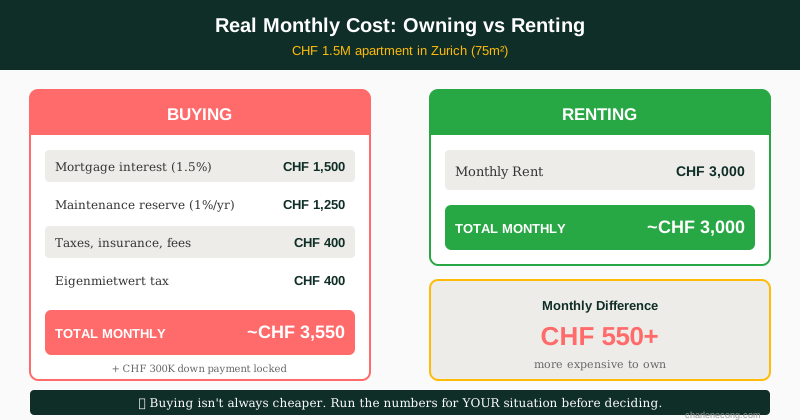
Renting the same apartment? Market rent around CHF 3,000 per month. Maybe CHF 3,200.
So owning costs CHF 500 to 1,000 more per month than renting. And you haven’t even started building equity yet, because Swiss mortgages don’t require full principal repayment like in other countries.
Buying a home sounds romantic. But the numbers? Not so much.
The Hidden Cost Nobody Talks About: Opportunity Cost
Here’s what really matters, and what most “rent vs buy” articles miss completely.
When you buy, you lock up CHF 300,000+ in a down payment. That money is gone from your investment portfolio. It sits in bricks and walls, not growing in the market.
What if you rented instead and invested that CHF 300,000?
Let’s say you put it in low cost global index funds earning an average 8% per year. Here’s what happens:
| Timeframe | Value of CHF 300,000 Invested at 8% |
|---|---|
| After 10 years | ~CHF 647,000 |
| After 20 years | ~CHF 1.4 million |
| After 30 years | ~CHF 3 million |
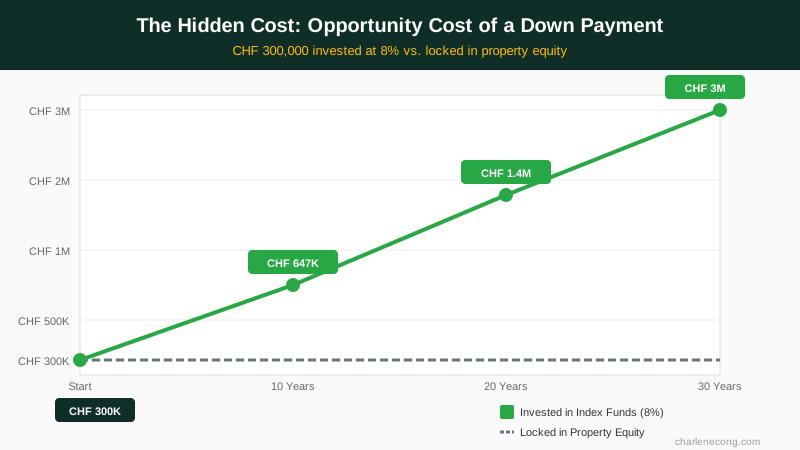
That’s the power of investing plus time. That’s liquidity. You can access it. Move it. Grow it.
A house, on the other hand? It’s not liquid. You can’t sell one bedroom to free up cash. You can’t access a little bit of it when markets crash or when you need money for an emergency.
If property prices go up, great. But they can also stagnate. Or fall. And all your wealth is concentrated in one single asset, in one single location.
My Personal View on Buy vs Rent
I’ve seen many friends burn themselves out saving for a down payment. Working crazy hours. Cutting back on everything. Just to afford a small apartment. Then they take on a massive mortgage and spend the next 30 years paying it off.
This is very common in Asia. In Hong Kong, in mainland China, in India. Owning a home is seen as a status symbol. It gives a feeling of security. I totally understand where it comes from.
But after living in Switzerland, my view changed a lot.
Honestly, if I had only CHF 300,000, I would not put most of it into a property and lock myself into a 20 or 30 year mortgage. It’s just not flexible enough. Life changes. Opportunities come and go. And a mortgage can feel like a golden cage.
As an expat, unless you are really sure you’ll stay here long term, I wouldn’t put more than half of my net worth into a house. There are smarter ways to use that money. Ways that can give you more freedom. And better returns.
Now, if you have CHF 500,000 saved, and you want to use CHF 200,000 for a down payment? That sounds much more reasonable. You still keep a healthy cash buffer. You still keep flexibility. Plus, with Switzerland’s very low interest rates, buying can make financial sense in that situation.
But only if it fits your bigger life plan.
Eigenmietwert: The Tax That’s Being Abolished
Before moving to Switzerland, I had never heard of this. Not in Hong Kong. Not in Singapore. Not anywhere.
It’s called Eigenmietwert in German. Imputed rental value. Basically, the Swiss government says: “You’re living in a home you own. That’s a financial benefit. So we’ll tax it, as if you were earning rent from yourself.”
Yes, it gets added to your taxable income. Even though no one is paying you anything.
Wild, right?
The good news: Swiss voters approved abolishing it on 28 September 2025. The vote passed with 57.7% in favor. It won’t take effect immediately, probably not until 1 January 2028 at the earliest. But it’s happening.
Here’s what changes:
| What’s Going Away | What Else Changes |
|---|---|
| No more imputed rental value tax | No more mortgage interest deduction |
| Simpler tax returns for homeowners | No more maintenance cost deduction |
Winners: Debt-free homeowners, retirees who’ve paid off their mortgage, people with minimal renovation needs.
Losers: Highly leveraged owners of older properties who relied on deductions for mortgage interest and maintenance costs.
If you’re buying now, factor this in. The whole calculus of whether to pay down your mortgage or invest will shift once deductions disappear. The incentive to maintain high mortgage debt drops significantly from 2028.
How to Buy Property in Switzerland: Step by Step
Here’s the actual process I went through when buying my apartment. It took several months from start to finish.
Step 1: Check Your Eligibility
Confirm your permit type and what restrictions apply. If you’re non-EU with a B permit like me, remember: primary residence only, and you cannot rent it out until you get a C permit.
If there’s any doubt, check with your canton’s land registry office. Rules can have cantonal variations.
Step 2: Get Your Finances Ready
You need a minimum 20% down payment. At least half of that must be “hard equity,” meaning cash or securities. The other half can come from your Pillar 2 or Pillar 3a pension funds, but only for a primary residence.
Banks also run an affordability stress test. They don’t use the actual mortgage rate. They use an imputed 5% rate to make sure you can handle payments if rates spike. The rule: total housing costs (mortgage interest at 5%, plus amortization, plus maintenance) cannot exceed 33% of your gross household income.
For a CHF 1 million property with a CHF 800,000 mortgage:
- Imputed interest at 5%: CHF 40,000
- Amortization (1%): CHF 8,000
- Maintenance (1%): CHF 10,000
- Total: CHF 58,000 per year
At 33%, you need a gross household income of roughly CHF 178,000. That’s the math banks use.
Step 3: Research Locations
Use Homegate, ImmoScout24, and Comparis to browse listings. But here’s a tip I learned: subscribe to newsletters directly from developers and agencies. They often share new projects there before listings hit third party platforms. That’s how I found my place.
Pay attention to the canton. Taxes and closing costs vary enormously. More on that below.
Step 4: Shop for Mortgages
I talked to three banks: UBS, ZKB, and a smaller boutique lender. We compared their offers on interest rates, flexibility (can you make extra payments?), and break fees if you refinance early.
The differences were meaningful. We picked the one with the lowest rate and most flexibility.
Three types of mortgages exist:
| Mortgage Type | How It Works | Best For |
|---|---|---|
| Fixed rate | Interest rate locked for 2 to 15 years | People who want certainty and stable payments |
| SARON (flexible) | Rate moves with the market, plus a bank premium | People who believe rates will stay low or fall |
| Mixed | Part fixed, part SARON | Balanced approach, hedging both scenarios |
Current rates as of March 2026:
- 10-year fixed: 1.33% to 1.66%
- SARON mortgages: 0.64% to 0.90% margin over the benchmark
- SNB policy rate: 0.0% (cut to zero in June 2025)
These are historically low rates. Much lower than the 4% to 6% my friends pay in the US or Hong Kong.
Step 5: Make an Offer and Do Due Diligence
Once you find a property, make an offer. If accepted, you’ll sign a reservation agreement and typically pay a small deposit (CHF 5,000 to 20,000).
Before signing the final contract:
- Get a property inspection if it’s not new construction
- For apartments, review the building’s reserve fund. Is it healthy or are special assessments coming?
- Read the Stockwerkeigentümerreglement (condo association rules). Can you renovate? Are there restrictions?
Step 6: Notary and Closing
All property transfers in Switzerland go through a notary. The notary handles the purchase contract, registration with the land registry, and payment of transfer taxes.
I remember signing a mountain of paperwork. It took almost half a day. Everything was in German. If you don’t speak the local language, you can sign an authorization form and bring someone you trust to help translate.
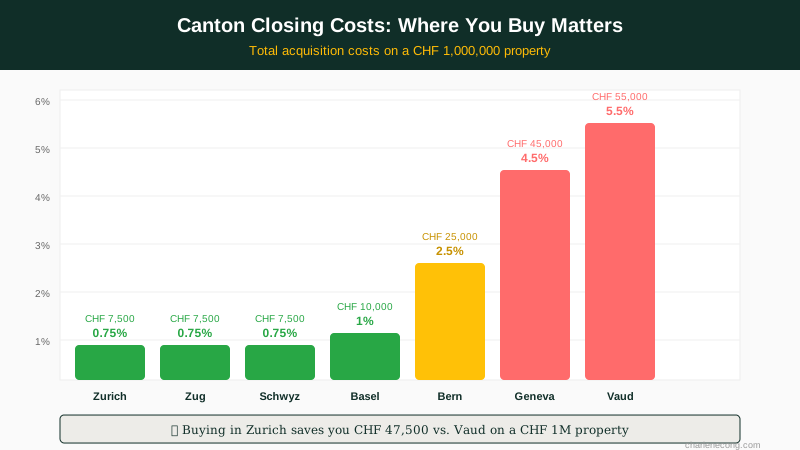
Closing costs include notary fees (0.1% to 0.5%) and, depending on the canton, transfer tax (0% to over 3%). Geneva and Vaud are expensive. Zurich and Zug have no transfer tax.
Canton Comparison: Where You Buy Matters
I cannot stress this enough. The canton where you buy has a massive impact on your total costs.
| Canton | Transfer Tax | Notary Fees | Total Closing Cost |
|---|---|---|---|
| Zurich | 0% | ~0.1-0.5% | ~0.5-1% |
| Zug | 0% | ~0.1-0.5% | ~0.5-1% |
| Schwyz | 0% | ~0.1-0.5% | ~0.5-1% |
| Basel-Stadt | 0% | ~0.5% | ~1% |
| Bern | 1.8% | ~0.3% | ~2.5% |
| Geneva | 3% | ~0.5% | ~4-5% |
| Vaud | 3.3% | ~0.5% | ~4-5.5% |
On a CHF 1 million property, that’s a difference of CHF 5,000 (Zurich) versus CHF 50,000+ (Geneva). A massive gap.
The German-speaking cantons generally have lower property taxes than the French-speaking ones. Check the map before you commit.
Also consider ongoing wealth tax. It varies from around 0.14% in Zug to 0.76% in Vaud. Over 20 years of ownership, that difference adds up to tens of thousands of francs.
5 Costly Mistakes Foreigners Make When Buying
1. Putting All Savings Into the Down Payment
If the down payment is everything you have, you’re starting from zero again. No emergency fund. No investment portfolio. No flexibility. I’ve seen friends do this and regret it within a year when unexpected expenses hit.
2. Ignoring the B Permit Rental Restriction
Non-EU B permit holders cannot rent out their property. If you get a job offer abroad or need to relocate, you’re stuck. You either sell (possibly at a loss) or leave it empty. This isn’t theoretical. The notary explicitly warned me about it.
3. Not Shopping for Mortgages
Banks have different rates, different margins, different flexibility terms. The difference between 1.3% and 1.6% might seem small, but on a CHF 1 million loan over 10 years, that’s CHF 30,000. Spend a few hours comparing. It pays off.
4. Forgetting About Eigenmietwert
Until 2028, you still pay tax on imputed rental value. Budget for it. Depending on your canton and income, it adds CHF 300 to 500 per month to your costs. Many buyers are surprised by this in their first tax return.
5. Buying in the Wrong Canton
A 5% difference in closing costs is CHF 50,000 on a CHF 1 million property. That’s real money you’re handing to the government. If you’re flexible on location, let the tax map guide you.
Why I Decided to Buy
I didn’t rush into buying when I moved to Switzerland from Hong Kong. It took me time. And a lot of thinking.
Over my 10 years in corporate life, I was very proactive about saving and investing. At some point, my savings and investments grew enough that even after paying a down payment, I still had strong liquidity. That was the first condition I set for myself.
I also didn’t do it alone. I bought together with my partner, which made the whole process much less stressful and more financially manageable.
Another key factor was opportunity cost. I ran the numbers. Given Switzerland’s low interest rates (still around 1% to 1.5% at the time) and the resilience of property prices, I realized owning could actually make financial sense. The math worked.
Emotionally, I was ready too. I planned to stay in Switzerland for at least a few more years. And owning gave me a stronger sense of belonging.
But I stayed strict with my rules:
- I didn’t buy the biggest property I could afford
- I didn’t stretch my budget
- I made sure I still had plenty of cash and investments on the side, for emergencies, for peace of mind
The down payment was only a fraction of my total savings and investments. That’s the key. If it had been most of my net worth, I would have kept renting.
Swiss Property Market 2026: What You Need to Know
A quick snapshot of where the market stands:
Prices are still rising, but slowing. National residential prices rose around 5.2% year over year through end of 2025. Forecasts for 2026 range from +2.8% (Wüest Partner) to +4.5% (ZKB). Not crazy growth, but still upward.
Zurich is expensive. Apartments trade at CHF 16,700 to 22,350 per square meter. Geneva is similar at CHF 15,800 to 21,450. Basel is more reasonable at CHF 10,700 to 13,100.
Bubble risk is moderate. The UBS Swiss Real Estate Bubble Index sits at 0.48, classified as “moderate” risk, well below the 1.0 elevated threshold. Zurich ranks third globally for bubble risk, behind Miami and Tokyo. Something to watch but not panic about.
Interest rates are historically low. The SNB policy rate is at 0.0%. Mortgage rates are the lowest they’ve been in years. This makes monthly ownership costs competitive with rent in many regions.
Supply is tight. Not enough new construction, strong demand from population growth. If you’re renting in a competitive area, you might fill out 50 applications before landing a place. This supply constraint supports prices.
Ready to Build Wealth Beyond Property?
Understanding Swiss real estate is important. But it’s just one piece of your financial puzzle.
In my free 90-minute masterclass, I’ll show you exactly how I built a 7-figure portfolio before I ever bought property, and how you can do the same.
→ Register for the Free Workshop
Or grab my free Investment Cheat Sheet to get started today.
FAQ: Buying Property in Switzerland as a Foreigner
Can a US citizen buy property in Switzerland?
Only if you’re a resident with a B or C permit. If you’re living in Switzerland on a work permit, you can buy a primary residence. If you’re a non-resident American living in the US, your only option is a holiday home in designated tourist zones, and those are limited.
How much deposit do I need to buy property in Switzerland?
Minimum 20% of the purchase price, with at least half as “hard equity” (cash, securities). The other half can come from pension funds (Pillar 2 or 3a) for a primary residence. For a CHF 1 million property, expect to bring at least CHF 200,000, ideally CHF 250,000+.
Can I use my Pillar 3a for a down payment?
Yes, for purchasing or building a primary residence. You can also use it for renovations or paying down your mortgage. The withdrawn amount is taxed at a reduced rate, separate from your regular income.
What happens if I leave Switzerland after buying?
Depends on your permit. Non-EU B permit holders cannot rent out their property. If you leave, you might need to sell. C permit holders and EU citizens have more flexibility. Always check the specific restrictions that were noted in your purchase contract.
Is it cheaper to buy or rent in Switzerland?
Monthly costs are often similar. Owning a CHF 1.5M Zurich apartment costs around CHF 3,500 to 4,000 per month; renting the same place costs around CHF 3,000. But buying requires locking up CHF 300,000+ in a down payment. If you invest that money instead, renting often wins over 20+ years. It depends on your assumptions about investment returns and property appreciation.
Why do Swiss people prefer to rent?
Switzerland has one of the lowest homeownership rates in Europe (around 36%). Reasons include: very high property prices, strong tenant protections, cultural preference for mobility, and historically attractive renting conditions. Many Swiss view real estate as just one investment option, not a life necessity.
What’s the minimum salary needed for a Swiss mortgage?
Banks use a 5% stress test rate. For a CHF 1 million property with 20% down and an CHF 800,000 mortgage, you need roughly CHF 178,000 gross household income. Higher priced properties require proportionally higher incomes.
Can I Airbnb my Swiss property?
Depends on the canton and your building’s rules. Some cantons restrict short-term rentals. Many condo associations prohibit or limit Airbnb in their regulations. Check both before assuming you can rent out short term.
What is Eigenmietwert and is it still in effect?
Eigenmietwert is a tax on the imputed rental value of your home. You’re taxed as if you were earning rent from yourself. Swiss voters approved abolishing it in September 2025, but it won’t take effect until around 2028. Until then, budget for it.
Should I get a fixed or SARON mortgage in 2026?
SARON mortgages are cheaper right now, with rates around 0.6% to 0.9%. But they move with the market. Fixed rates (1.3% to 1.7% for 10 years) give you certainty. If you think rates will stay low or fall further, SARON saves money. If you want peace of mind and predictable payments, go fixed. Many buyers split it with a mixed mortgage.

Charlene Cong, CFA, based in Zurich, Switzerland, is the founder of FinFit Solution and VISION Investment Academy. She is a seasoned Chartered Financial Analyst (CFA) with over a decade of experience in finance and banking across Asia and Europe.
Her career includes a notable tenure at JPMorgan and serving as an executive board member of the Swiss Capital Market Forum Association. She also has over seven years of experience as a banking journalist, where she investigated the investment strategies of high-net-worth individuals.