

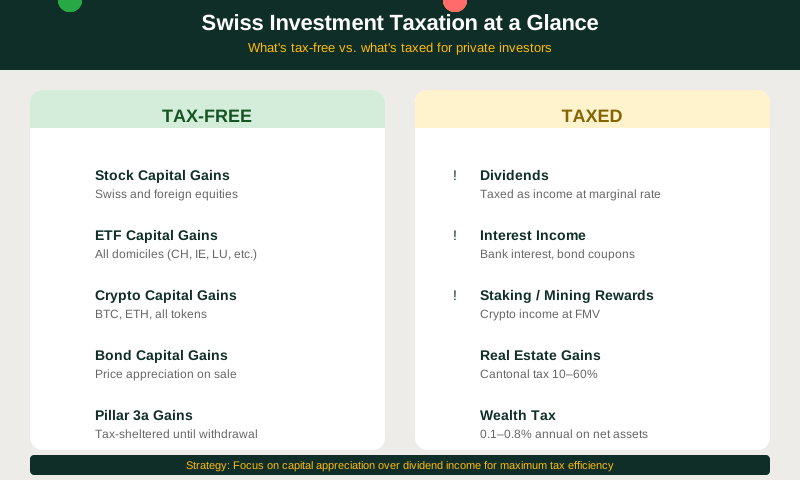
Is there capital gains tax in Switzerland? No. Private investors pay zero capital gains tax on stocks, ETFs, bonds, and cryptocurrency. This exemption is written into federal law (Article 16, paragraph 3 DBG) and applies at all three tax levels. However, real estate profits are taxed at cantonal rates, and investors classified as “professional traders” lose the exemption entirely.
When I first moved to Switzerland and started building my investment portfolio, the tax rules seemed almost too good to be true. Coming from a background where I’d watched institutional investors at JPMorgan structure complex strategies just to minimize capital gains exposure, discovering that Switzerland simply doesn’t tax private investment gains felt like finding a cheat code for wealth building.
As a CFA charterholder who has now built a seven-figure portfolio, I can tell you this exemption is real, and it’s one of the most powerful structural advantages Switzerland offers to investors. But here’s what most expats don’t realize: this generous treatment comes with invisible boundaries. Cross the wrong line, and you could face income tax rates of 40% or more on every franc of profit.
In this guide, I’ll walk you through exactly how Swiss capital gains taxation works in 2026, the five criteria that protect your tax-free status, and the practical strategies I use to stay firmly on the right side of the rules.
Why Switzerland Doesn’t Tax Your Investment Gains
The exemption isn’t a loophole or a temporary incentive. It’s embedded in the foundation of Swiss tax law. Article 16, paragraph 3 of the Federal Act on Direct Federal Tax (DBG/LIFD) explicitly states that capital gains from selling private movable assets are not subject to federal income tax. The Federal Tax Harmonisation Act (StHG) extends this exemption to cantonal and municipal levels as well.
This means the zero rate applies across all three layers of Swiss government. When you buy CHF 100’000 of a global ETF and sell it ten years later for CHF 400’000, you owe precisely zero in capital gains tax, provided you maintain your status as a private investor.
The scope is remarkably broad. Swiss and foreign stocks, ETFs, index funds, bonds, cryptocurrencies, derivatives held as private assets, even collectibles. All of these qualify for the exemption. There’s no minimum holding period required, no annual cap on gains, and no phase-out at higher income levels.
Why this matters globally: While the US taxes long-term gains at up to 23.8%, the UK at 24%, Germany at 26.4%, and France at over 30%, Swiss residents keep 100% of their investment profits. For a CHF 500’000 gain, that’s a difference of CHF 120’000 or more staying in your pocket.
The trade-off is symmetrical: private capital losses cannot be deducted against any income. Dividends and interest remain fully taxable, Swiss dividends face a 35% withholding tax (refundable upon declaration), and all assets are subject to annual cantonal wealth tax. But for investors focused on long-term capital appreciation (which is exactly the strategy I recommend), Switzerland’s structural advantage is unmatched among developed economies.
The Five Criteria That Protect Your Tax-Free Status
The most consequential risk for any active investor in Switzerland is reclassification as a gewerbsmässiger Wertschriftenhändler, a professional securities trader. The Swiss Federal Tax Administration’s Circular No. 36 (Kreisschreiben Nr. 36), published July 27, 2012, establishes five cumulative “safe harbor” criteria. If you meet all five simultaneously, the tax authorities will treat you as a private investor with tax-free capital gains.
| Criterion | Requirement | Why It Matters |
|---|---|---|
| 1. Holding Period | Minimum 6 months | Short-term trading signals speculative intent |
| 2. Transaction Volume | Below 5× portfolio value annually | High turnover suggests trading as a business |
| 3. Gains vs Income | Capital gains under 50% of net income | Trading shouldn’t be your primary livelihood |
| 4. No Leverage | No borrowed capital for investments | Debt-financed investing signals professional approach |
| 5. Derivatives | Only for hedging existing positions | Speculative options trading is a red flag |
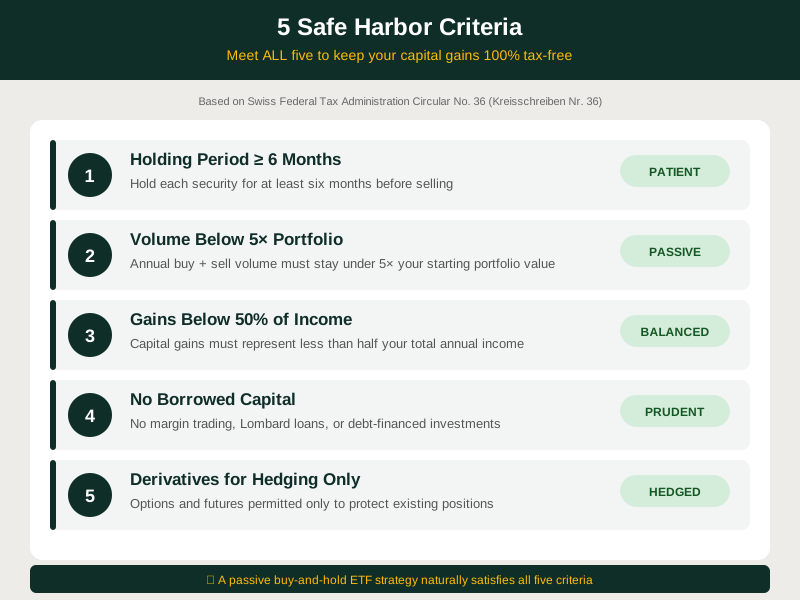
Let me break down each criterion with the practical thresholds that matter.
Criterion 1: Holding period of at least six months. Every security you sell should have been held for a minimum of six months. The longer the better. This doesn’t mean you can never sell something early, but a pattern of short-term trades will trigger scrutiny. I personally hold my core ETF positions for years, sometimes decades.
Criterion 2: Transaction volume below 5× portfolio value. If you start the year with a CHF 200’000 portfolio, your total buy and sell volume should stay below CHF 1’000’000 for the year. This is the most quantitative criterion and the easiest to monitor. A passive buy-and-hold strategy naturally stays well under this threshold.
Criterion 3: Capital gains below 50% of net income. Your realized gains must represent less than half of your total income. This criterion exists to ensure securities trading isn’t your primary livelihood. It becomes particularly important for early retirees or those pursuing financial independence with limited employment income.
Criterion 4: No debt-financed investments. No margin trading, no Lombard loans, no leverage of any kind. If you do have debt and investment income, your dividends and interest must exceed the interest costs on that debt. Using borrowed money to invest signals an entrepreneurial, professional approach.
Criterion 5: Derivatives restricted to hedging only. You can use options and futures, but only to protect existing positions, not for speculative profit. Writing naked options, trading futures directionally, or maintaining large derivative positions relative to your portfolio are all red flags.
What Happens If You’re Classified as a Professional Trader
Failing a single criterion doesn’t automatically trigger professional classification. The tax authorities conduct a deeper assessment based on the totality of circumstances. Federal Supreme Court rulings have established that transaction volume and frequency carry the most weight, followed by use of borrowed funds and speculative derivative trading.
However, the consequences of reclassification are severe. All capital gains become taxable as self-employment income under Article 18 DBG. This means progressive income tax at federal, cantonal, and municipal levels, with combined marginal rates of 22% to 45% depending on where you live. On top of that, you’ll owe AHV/IV/EO social security contributions at 10.0% of net earned income for amounts above CHF 60’500 annually.
The classification is essentially permanent. Once you’re deemed a professional trader, it “taints” all your securities activity going forward. The one silver lining: losses become deductible, business expenses can be written off, and losses can be carried forward for seven years. But these benefits rarely compensate for the tax and social security burden.
Here’s the reassuring reality, though. In my experience working with Swiss tax professionals, very few people actually get classified as professional investors. As Kevin Waltz, a tax advisor with over 15 years of experience in Swiss taxation, told me in a recent workshop: “Unless you are day-trading, making many transactions, or using options to trade, you should not worry much about your investor status.”
A passive, buy-and-hold ETF strategy (which is exactly what I teach in my VISION Academy course) trivially satisfies all five criteria. I’ve been investing for over a decade in Switzerland and have never come close to triggering any of these thresholds.
Real Estate: The Major Exception to Tax-Free Gains
Unlike movable assets, profits from selling Swiss real estate are always taxable under the Grundstückgewinnsteuer, a cantonal and municipal tax with no federal component. The canton where the property is physically located has jurisdiction, and rates vary dramatically.
If you’re considering buying property in Switzerland as an expat, I’ve written a complete guide to buying property as a foreigner that covers the Lex Koller restrictions and the honest buy-versus-rent math.
| Canton | Rate (Year 1) | Rate (10+ Years) | Maximum Reduction |
|---|---|---|---|
| Zurich | 40% (+50% surcharge) | ~20% | 50% after 20 years |
| Geneva | 50% | 10% | 0% after 25 years |
| Basel-Stadt | 60% | 30% | Flat from year 9 |
| Zug | 30% | ~10% | Progressive reduction |
| Note: Geneva is the only major canton offering complete exemption (0%) after 25 years of ownership | |||
The principle across all cantons is consistent: speculation is penalized, patient ownership is rewarded. If you’re buying property as a long-term home rather than a short-term flip, the eventual tax burden becomes much more manageable.
Dividends Are Taxed: Why I Focus on Growth
While capital gains are tax-free, dividends are fully taxable as income at your marginal rate. This creates a clear incentive for tax-efficient investing: growth-oriented investments that don’t distribute dividends keep more money compounding in your pocket.
Personally, I don’t hold many dividend stocks. Even when I do own shares that pay dividends, I prefer to reinvest them back into the market rather than take them as income. The math is simple: if you’re in a 35% marginal tax bracket and receive CHF 10’000 in dividends, you keep CHF 6’500. If instead that CHF 10’000 comes as capital appreciation, you keep all CHF 10’000.
Switzerland also imposes a 35% withholding tax (Verrechnungssteuer) on Swiss dividends at source. This isn’t a final tax; it’s a compliance mechanism. Swiss residents who correctly declare their investment income receive a full refund, either as a credit against their tax liability or as a cash payment. The process is largely automated through cantonal e-tax software when you list your securities properly.
For foreign dividends, Switzerland has double taxation agreements with over 100 countries. Most treaties reduce the foreign withholding tax to 15%. You can then claim a credit for this amount using the DA-1 form filed with your Swiss tax return, with a minimum claim threshold of CHF 100.
Tax-efficient fund selection: Irish-domiciled ETFs (UCITS) often have favorable withholding tax treatment compared to US-domiciled funds. An Irish ETF holding US stocks pays 15% withholding on US dividends (vs. 30% for direct US investment without a W-8BEN), and Ireland doesn’t charge additional withholding to Swiss residents.
Cryptocurrency: Still Tax-Free, But Enforcement Is Tightening
Private investors pay no capital gains tax on cryptocurrency in Switzerland. Bitcoin, Ethereum, and all other tokens are classified as movable intangible private assets, subject to the same zero-rate exemption as stocks and bonds. Even crypto-to-crypto swaps (exchanging BTC for ETH, for example) are tax-neutral events.
However, the picture changes for active crypto participants. Mining income is taxed as self-employment income. Staking rewards are taxed as income from movable property at fair market value when credited. Airdrops, DeFi yields, and liquidity mining returns are all taxable income.
The professional trader criteria from Circular No. 36 apply to crypto by analogy, and crypto traders face heightened reclassification risk. The ecosystem naturally involves high transaction frequency (token swaps often require intermediate tokens), short holding periods driven by volatility, and growing availability of leverage products.
Coming in 2027: Switzerland will implement the OECD’s Crypto-Asset Reporting Framework (CARF), requiring crypto service providers to collect and report transaction data for automatic international exchange beginning around 2028. This represents a major shift in enforcement capability. The days of unreported crypto holdings are ending.
For wealth tax purposes, all crypto holdings must be declared at year-end values using the official rates published by the Federal Tax Administration on the ICTax portal. For 2025, official values were CHF 69’572 for Bitcoin and CHF 2’364 for Ethereum.
Wealth Tax: The Annual Cost of Holding Assets
Switzerland is one of only four OECD countries that levies an annual net wealth tax. This is exclusively a cantonal and municipal tax with no federal wealth tax. It applies to Swiss residents on worldwide net assets as of December 31, including bank accounts, investment portfolios, real estate, cryptocurrency, and business interests. Pillar 2 and Pillar 3a retirement assets are excluded.
The cantonal variation is enormous. I had colleagues back when I was working in Zurich who chose to live in Zug specifically for the tax savings, and the difference is real.
| Canton | CHF 1M Net Wealth | CHF 5M Net Wealth | Effective Rate |
|---|---|---|---|
| Nidwalden | ~CHF 1’250 | ~CHF 6’260 | 0.10–0.13% |
| Zug | ~CHF 1’800 | ~CHF 9’500 | 0.09–0.21% |
| Zurich | ~CHF 2’500 | ~CHF 15’000 | 0.15–0.30% |
| Geneva | ~CHF 5’500 | ~CHF 38’100 | 0.40–0.76% |
| Neuchâtel | ~CHF 6’800 | ~CHF 34’000 | 0.55–0.68% |
For a CHF 5 million portfolio, the difference between Nidwalden and Geneva is over CHF 30’000 per year. That said, even Geneva’s wealth tax is modest compared to the capital gains tax you’d pay on a CHF 500’000 gain in the US (CHF 119’000) or UK (CHF 120’000).
How Switzerland Compares to Global Capital Gains Taxes
| Country | Top CGT Rate | Key Features |
|---|---|---|
| Switzerland | 0% | Private movable assets fully exempt; wealth tax instead |
| Singapore | 0% | No CGT for individuals; no wealth tax |
| Hong Kong | 0% | No CGT or dividend tax |
| Germany | ~26.4% | Flat 25% + solidarity surcharge; crypto exempt after 1 year |
| USA | 23.8% | 20% federal + 3.8% NIIT; short-term up to 37% |
| UK | 24% | Unified rates from Oct 2024; £3’000 annual exemption |
| France | 30–34% | PFU flat tax ~31%; high-income surtax possible |
| Italy | 26–33% | 26% on securities; crypto increased to 33% from 2026 |
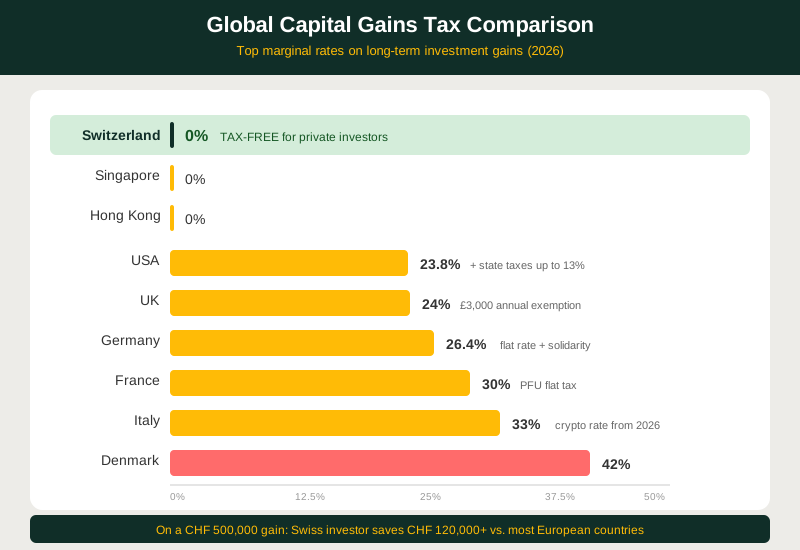
Switzerland’s advantage extends beyond the headline rate. Unlike Singapore and Hong Kong (which also charge 0%), Switzerland combines tax-free capital gains with a deep network of double taxation treaties, political stability, a strong legal framework, and EU market proximity.
Practical Strategies to Stay Tax-Free
The overarching principle is straightforward: invest like a long-term wealth builder, not a short-term trader. A passive, buy-and-hold ETF strategy trivially satisfies all five safe harbor criteria. Here’s what I do personally:
Hold for the long term. My core positions stay in my portfolio for years, often decades. I’m not trying to time the market. I’m building wealth through compound growth. This naturally keeps me well above the six-month holding requirement.
Keep transaction volume low. I make regular contributions to my portfolio (similar to dollar-cost averaging), but I rarely sell. My annual transaction volume is a tiny fraction of the 5× threshold.
Maintain employment or pension income. Even in early retirement, having income from sources other than trading (whether from pension withdrawals, rental income, or consulting work) ensures capital gains stay below 50% of total income.
Never use leverage. No margin accounts, no Lombard loans, no borrowed money for investing. This rule is absolute.
Avoid speculative derivatives. I don’t trade options for profit. If I ever used derivatives, it would only be to hedge an existing position, but honestly, with a diversified global ETF portfolio, I’ve never felt the need.
Focus on growth over dividends. For me, 100% equities in my Pillar 3a, and growth-oriented global ETFs in my taxable accounts. I minimize dividend income because it’s taxed, while capital appreciation is not.
If you want to learn the complete investment strategy I used to build a seven-figure portfolio, including how to structure your Swiss accounts for maximum tax efficiency, I cover everything in my free 90-minute masterclass.
What’s Changed in 2025–2026
The most significant structural change is the individual taxation reform approved by Swiss voters on March 8, 2026, with 54.26% support. This historic shift ends joint taxation for married couples, requiring each spouse to file separately. Implementation is expected by 2032. The reform will particularly benefit dual-income couples who previously faced the so-called “marriage penalty.”
On November 30, 2025, voters decisively rejected (78% against) an inheritance tax initiative proposing a 50% tax on estates exceeding CHF 50 million. This rejection reinforces Switzerland’s political resistance to new capital taxes. No federal capital gains tax initiative is currently pending.
For crypto investors, the OECD Crypto-Asset Reporting Framework takes effect with reporting obligations beginning January 1, 2026, and first data exchanges in 2027. Switzerland now exchanges financial information with 110 partner countries automatically.
Frequently Asked Questions
Do expats pay capital gains tax in Switzerland?
No. Expats who are Swiss tax residents receive the same zero capital gains tax treatment as Swiss citizens. The exemption applies regardless of your nationality, permit type, or country of origin. However, you must declare all worldwide assets and investment income in your Swiss tax return.
Is there a holding period requirement for tax-free gains?
There’s no legal minimum holding period for capital gains to be tax-free. However, to maintain your status as a private investor under the safe harbor rules, securities should generally be held for at least six months. Shorter holding periods can trigger scrutiny for professional trader classification.
Are ETF gains tax-free in Switzerland?
Yes. Capital gains from selling ETFs are tax-free for private investors, whether the ETFs are domiciled in Switzerland, Ireland, Luxembourg, or elsewhere. However, dividends distributed by the ETF (or reinvested in accumulating funds) are taxable income.
How many trades can I make before being classified as professional?
There’s no specific number of trades that triggers classification. The key metric is transaction volume: total purchases plus sales should stay below five times your portfolio value annually. A few hundred trades could be fine if they’re small; a handful of very large trades could raise flags if they exceed the 5× threshold.
Is Bitcoin taxed in Switzerland?
Capital gains from Bitcoin are tax-free for private investors. However, Bitcoin holdings are subject to annual wealth tax and must be declared at year-end using official Federal Tax Administration values. Mining and staking rewards are taxable as income.
What happens if I lose money on investments?
Capital losses on private investments cannot be deducted against any income in Switzerland. This is the trade-off for tax-free gains. Losses simply reduce your wealth (and thus your wealth tax), but they don’t generate any tax benefit.
Do I need to report foreign investments?
Yes. Swiss tax residents must declare all worldwide investments, including foreign brokerage accounts, real estate, and cryptocurrency held on international exchanges. Failure to report can result in penalties and back taxes with interest.
How do I reclaim the 35% withholding tax on Swiss dividends?
The withholding tax is automatically refunded when you correctly declare your dividend income in your annual tax return. The refund appears either as a credit against taxes owed or as a cash payment. If you fail to declare the income, you forfeit the refund permanently.
Which canton has the lowest taxes for investors?
For wealth tax, Nidwalden, Obwalden, Schwyz, and Zug offer the lowest rates. For overall tax burden including income tax on dividends, Zug and Schwyz typically rank highest for high-net-worth investors. The optimal choice depends on your income level, wealth, and personal circumstances.
Can I use Pillar 3a for tax-free investing?
Pillar 3a contributions are tax-deductible (up to CHF 7’258 in 2025 for employees), and gains within the account are completely tax-free. Withdrawals are taxed at a reduced rate upon retirement. I maximize my Pillar 3a every year and invest it 100% in equities for long-term growth. It’s one of the most powerful tax-advantaged accounts available.
Ready to Build a Tax-Efficient Portfolio?
In my free 90-minute masterclass, I’ll show you exactly how I built a seven-figure investment portfolio, including the tax-efficient strategies that let you keep more of what you earn.
Disclaimer: This article is for educational purposes only and does not constitute tax or investment advice. Tax laws are complex and subject to change. The information provided reflects the author’s understanding as of March 2026 and may not apply to your specific situation. Consult a qualified Swiss tax advisor before making decisions based on this content.

Charlene Cong, CFA, based in Zurich, Switzerland, is the founder of FinFit Solution and VISION Investment Academy. She is a seasoned Chartered Financial Analyst (CFA) with over a decade of experience in finance and banking across Asia and Europe.
Her career includes a notable tenure at JPMorgan and serving as an executive board member of the Swiss Capital Market Forum Association. She also has over seven years of experience as a banking journalist, where she investigated the investment strategies of high-net-worth individuals.